
Introduction
Saving for retirement is one of the most important financial goals you’ll ever tackle. Yet many people leave significant money on the table by not understanding—or not properly utilizing—the tax-advantaged retirement accounts available to them.
The difference between saving in a regular taxable brokerage account versus a tax-advantaged retirement account can be staggering. Over a 30-year career, that difference can easily exceed $100,000 in additional savings and tax benefits.
Tax-advantaged retirement accounts come in many forms, each with its own rules, contribution limits, and tax treatments. Choosing the right combination for your situation is one of the most impactful financial decisions you’ll make.
https://trendminers.online/how-to-reduce-your-tax-burden-legally/
In this comprehensive guide, you’ll learn about every major tax-advantaged retirement account available in 2024, how they compare, and strategies to maximize your retirement savings while minimizing your current tax burden. Whether you’re just starting your career or approaching retirement, this guide will help you make the most of every dollar you save.
Why Tax-Advantaged Accounts Matter
Before diving into specific account types, let’s understand why tax-advantaged retirement accounts are so powerful.
The three types of tax treatment:
Tax-deferred accounts: Contributions reduce your taxable income now. Your money grows tax-free while in the account. Withdrawals in retirement are taxed as ordinary income.
- Examples: Traditional 401(k), Traditional IRA, SEP IRA, SIMPLE IRA
- Benefit: Immediate tax savings when you need it most
- Trade-off: You’ll pay taxes later, potentially at a lower rate in retirement
Tax-free growth accounts (Roth): Contributions are made with after-tax dollars (no deduction now). Your money grows tax-free. Qualified withdrawals in retirement are completely tax-free.
- Examples: Roth 401(k), Roth IRA
- Benefit: Tax-free income in retirement
- Trade-off: No immediate tax deduction
Taxable accounts: Contributions are made with after-tax dollars. You pay taxes on dividends, interest, and capital gains each year. These are NOT tax-advantaged retirement accounts.
- Examples: Standard brokerage accounts, savings accounts
- Benefit: No contribution limits, no withdrawal restrictions
- Trade-off: Taxes reduce your returns every year
The power of tax-deferred growth:
Let’s compare investing $5,000 annually for 30 years at 7% average annual return:
Taxable account (25% tax on gains annually):
- Total contributions: $150,000
- Final value: Approximately $380,000
Tax-advantaged account (tax-deferred):
- Total contributions: $150,000
- Final value: Approximately $505,000
Difference: Over $125,000 — simply by deferring taxes on investment gains.
Now let’s consider the tax benefit of pre-tax contributions:
If you’re in the 24% tax bracket and contribute $5,000 to a traditional 401(k):
- You save $1,200 in federal taxes immediately
- That $1,200 can be invested additionally or used for other goals
Compounding is the eighth wonder of the world — and tax-advantaged accounts maximize its power.
https://trendminers.online/tax-deductions-everyone-should-know-in-2026/
Traditional 401(k): The Workplace Workhorse
The 401(k) is the most common employer-sponsored retirement account in America.
How it works:
You elect to contribute a percentage of your pre-tax salary to your 401(k). Your employer may match a portion of your contributions. The money is invested in funds you choose from your plan’s options.
2024 Contribution Limits:
- Employee deferral limit: $23,000
- Catch-up contribution (age 50+): Additional $7,500
- Total limit (including employer match): $69,000 ($76,500 with catch-up)
Key features:
Pre-tax contributions: Your contributions reduce your taxable income for the year. If you earn $75,000 and contribute $15,000, your taxable income drops to $60,000.
Tax-deferred growth: Investment earnings grow without being taxed each year.
Employer match: This is FREE MONEY. Contribute at least enough to get the full employer match before anything else.
Tax treatment at withdrawal: Withdrawals in retirement are taxed as ordinary income. If you’re in a lower tax bracket in retirement (which is common), this is advantageous.
Required Minimum Distributions (RMDs): You must begin withdrawing from your traditional 401(k) by age 73 (starting in 2024; age 75 if born after 1960).
Pros of Traditional 401(k):
- Immediate tax deduction
- High contribution limits
- Employer match opportunity
- Automatic payroll deductions
- Creditor protection (ERISA)
Cons of Traditional 401(k):
- Limited to your employer’s investment options
- Fees may be higher than individual options
- RMDs required
- Early withdrawal penalty (10% before age 59½, with exceptions)
- Withdrawals taxed as ordinary income
Maximization strategy:
- Contribute at least enough to get the full employer match (free money)
- Increase contributions by 1-2% each year or whenever you get a raise
- Invest in low-cost index funds
- Understand your plan’s fee structure and investment options
- Consider consolidating old 401(k)s to IRAs when changing jobs
Roth 401(k): The Hybrid Option
The Roth 401(k) combines features of a traditional 401(k) and a Roth IRA.
How it works:
You make after-tax contributions to your 401(k). The money grows tax-free, and qualified withdrawals in retirement are completely tax-free.
2024 Contribution Limits:
- Same as traditional 401(k): $23,000 employee deferral
- Catch-up: Additional $7,500 (age 50+)
- Combined traditional + Roth 401(k) contributions can’t exceed the limit
Key features:
After-tax contributions: No immediate tax deduction, but contributions and earnings are never taxed again if withdrawals are qualified.
Qualified withdrawals: Tax-free if you’re 59½ or older and the account has been open for at least 5 years.
Employer match: Employer matches are made on a pre-tax basis (traditional), even if your contributions are Roth. You’ll have a mix of pre-tax and after-tax money.
RMDs: Roth 401(k)s are subject to RMDs starting at age 73 (unless you roll over to a Roth IRA before then).
Pros of Roth 401(k):
- Tax-free retirement income
- No immediate tax impact (good if you’re in a low tax bracket now)
- Higher contribution limits than Roth IRA
- Diversification of tax treatment
Cons of Roth 401(k):
- No immediate tax deduction
- RMDs apply (unlike Roth IRAs)
- Limited to employer’s investment options
- Fees may be higher
Who should choose Roth 401(k)?
- Young workers in low tax brackets who expect higher income later
- Those who want tax-free income in retirement
- Workers who already maximize traditional pre-tax contributions
- Those who expect tax rates to rise in the future
Strategy: Some financial advisors recommend splitting contributions between traditional and Roth to create “tax diversification” in retirement.
Traditional IRA: Individual Retirement Account
A Traditional IRA is an individual retirement account you open independently, not through an employer.
How it works:
You contribute after-tax money to the account (or pre-tax if you qualify for a deduction), and potentially deduct contributions from your taxable income.
2024 Contribution Limits:
- Limit: $7,000 per year
- Catch-up (50+): Additional $1,000
- If you have multiple IRAs, the limit applies to the total across all IRAs
Deductibility rules:
Your Traditional IRA contribution may be tax-deductible depending on:
- Whether you or your spouse have access to a workplace retirement plan
- Your Modified Adjusted Gross Income (MAGI)
- Your filing status
2024 MAGI limits for deductible Traditional IRA contributions:
If covered by a workplace retirement plan:
- Single: Deduction phases out $77,000-$87,000
- Married filing jointly: Phases out $123,000-$143,000
- Married filing separately: Phases out $0-$10,000
If not covered by a workplace retirement plan (but spouse is):
- Married filing jointly: Phases out $230,000-$240,000
If neither spouse is covered: Full deduction available regardless of income
Key features:
Investment flexibility: You can invest in nearly anything—stocks, bonds, ETFs, mutual funds, real estate, and more.
Tax-deferred growth: Earnings grow tax-free until withdrawal.
Tax treatment at withdrawal: Withdrawals taxed as ordinary income. RMDs begin at age 73.
Early withdrawal: 10% penalty before age 59½ (exceptions apply for first-time home purchase up to $10,000, education expenses, and more).
Pros of Traditional IRA:
- Potentially tax-deductible contributions
- Wide investment options
- Low cost (if you choose low-fee providers)
- Can be funded until tax day (April 15) of the following year
- Consolidation vehicle for old 401(k)s
Cons of Traditional IRA:
- Lower contribution limits than 401(k)
- Potential deduction limitations if you have workplace retirement plan
- RMDs required
- Early withdrawal penalties
Roth IRA: The Retirement Powerhouse
The Roth IRA is widely considered the most powerful retirement vehicle available for most individuals.
How it works:
You contribute after-tax money to a Roth IRA. The money grows tax-free, and qualified withdrawals in retirement are completely tax-free—including all investment earnings.
2024 Contribution Limits:
- Limit: $7,000 per year
- Catch-up (50+): Additional $1,000
Income eligibility for 2024:
Single filers:
- Full contribution allowed if MAGI is under $146,000
- Phase-out range: $146,000-$161,000
- Not eligible if MAGI exceeds $161,000
Married filing jointly:
- Full contribution if MAGI is under $230,000
- Phase-out range: $230,000-$240,000
- Not eligible if MAGI exceeds $240,000
Key features:
Tax-free withdrawals: Qualified withdrawals are 100% tax-free, including growth.
Contributions can be withdrawn anytime: You can withdraw your original contributions (not earnings) at any time without taxes or penalties.
No RMDs: Roth IRAs have NO Required Minimum Distributions during your lifetime. You can keep money growing as long as you live.
Backdoor Roth: High earners can use the “backdoor Roth” strategy by making non-deductible Traditional IRA contributions and then converting to a Roth IRA. This is a legal workaround for income limits.
Pros of Roth IRA:
- Tax-free retirement income
- No RMDs (more estate planning flexibility)
- Contributions can be withdrawn anytime (penalty-free)
- Wide investment options
- Better than a taxable account for long-term savings
Cons of Roth IRA:
- No immediate tax deduction
- Income limits restrict eligibility
- Lower contribution limit than 401(k)
Who should choose a Roth IRA?
- Young professionals in lower tax brackets
- Those who expect to be in a higher tax bracket in retirement
- Individuals who want tax-free retirement income
- Those who want to pass money to heirs tax-free
[IMAGE PROMPT: Create a comprehensive comparison infographic showing four retirement account types side-by-side: Traditional 401(k), Roth 401(k), Traditional IRA, and Roth IRA. Include for each: contribution limit icon, tax treatment visual (pre-tax vs after-tax), RMD note, income limit indicator, and best use case. Use a table-like visual design with columns for each type and rows for: 2024 Limit, Tax Treatment, Employer Match, RMDs Required, Income Limits. Color-code: Traditional accounts in blue (deferred tax), Roth accounts in green (tax-free). Include a simple arrow diagram showing money flow: contribution stage → growth stage → withdrawal stage with tax implications labeled at each step. Style: Clean, data-dense but scannable, professional infographic.]
Image Placement: After the IRA sections
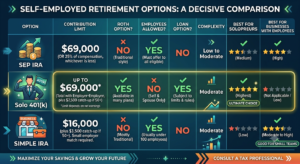
SEP IRA: Simplified Employee Pension for Self-Employed
The SEP IRA is one of the most powerful retirement savings tools for self-employed individuals and small business owners.
How it works:
A SEP IRA allows you (as a business owner or self-employed individual) to contribute to your own retirement account and (optionally) accounts for eligible employees. Contributions are made by the employer (you), not the employee.
2024 Contribution Limits:
- Maximum contribution: 25% of net self-employment income or $69,000, whichever is less
How the 25% calculation works:
For self-employed individuals, the calculation is slightly confusing. Since your contribution reduces your net income, the effective rate is 20% of your net business income before contributions.
Example calculation:
- Net self-employment income: $100,000
- SEP IRA contribution: 20% × $100,000 = $20,000
- This is equivalent to 25% of the income AFTER your contribution: $100,000 × 0.20 = $20,000 (and $20,000 is 25% of $80,000)
Simplified formula: SEP contribution = Net profit × 0.20 (for self-employed with no employees)
Key features:
Pre-tax contributions: Contributions reduce your taxable income AND self-employment tax.
No employee contributions: Only the employer (you) contributes. Employees can’t add their own money.
Employer obligation: If you have eligible employees, you generally must contribute the same percentage of their salary as you contribute for yourself.
Tax treatment: Contributions are tax-deductible as a business expense. Earnings grow tax-deferred. Withdrawals in retirement are taxed as ordinary income.
Deadline: Contributions can be made until the business tax filing deadline (usually April 15, with extensions to October 15).
Pros of SEP IRA:
- High contribution limits
- Simple to set up and maintain
- Tax-deductible contributions
- Reduces self-employment tax
- Flexible contributions (can contribute more in profitable years, less in lean years)
Cons of SEP IRA:
- No Roth option (pre-tax only)
- Must contribute for eligible employees
- No catch-up contributions for those 50+
- Prohibits employee contributions (employees can’t add their own salary)
For self-employed individuals, the SEP IRA is one of the best tools to reduce your current tax burden while building retirement wealth.
Solo 401(k): Maximum Savings for Self-Employed
The Solo 401(k) (also called Individual 401(k)) offers the highest contribution potential for self-employed individuals with no employees (other than a spouse).
How it works:
Similar to an employer 401(k), but you wear both hats—employee and employer. You can contribute as both the employee (salary deferral) and the employer (profit-sharing contribution).
2024 Contribution Limits:
- Employee salary deferral: $23,000 ($30,500 if 50+)
- Employer profit-sharing contribution: Up to 25% of compensation
- TOTAL limit: $69,000 ($76,500 with catch-up)
Example with $120,000 net income:
- Employee deferral: $23,000
- Employer contribution (20% of net income): $24,000
- Total Solo 401(k) contribution: $47,000
Example with $200,000 net income:
- Employee deferral: $23,000
- Employer contribution (25%): $46,000
- Total: $69,000 (maximum allowed)
Key features:
Roth option available: Many providers allow Roth contributions within a Solo 401(k), giving you both pre-tax and after-tax options.
Loan provision: You can borrow from your Solo 401(k) up to $50,000 or 50% of vested balance, whichever is less.
No employee conflicts: Since you have no employees, you have maximum flexibility and control.
Higher limits than SEP IRA: The Solo 401(k) allows up to $69,000 with the same income level where a SEP IRA might allow less.
Tax treatment: Pre-tax contributions reduce your taxable income. Roth contributions provide tax-free growth. Earnings grow tax-deferred (or tax-free for Roth).
Deadline: Contributions can be made until the business tax filing deadline.
Pros of Solo 401(k):
- HIGHEST contribution limits available
- Roth option available
- Loan provisions
- Reduces both income tax and self-employment tax
- More control than employer-sponsored plans
- No annual filing requirement (until assets exceed $250,000)
Cons of Solo 401(k):
- Must have no employees (other than a spouse)
- More paperwork initially to establish
- Requires separate EIN for the plan (in some cases)
- Employer contribution must be calculated carefully
Comparison: SEP IRA vs Solo 401(k)
- Solo 401(k) allows higher contributions at lower income levels
- Solo 401(k) offers Roth option; SEP IRA does not
- SEP IRA is simpler to set up; Solo 401(k) requires more administration
- SEP IRA works better if you have employees
- Solo 401(k) allows loans; SEP IRA does not
Recommendation: For single freelancers and solopreneurs with no employees, the Solo 401(k) is almost always the superior choice over the SEP IRA.
https://trendminers.online/self-employed-tax-guide/
SIMPLE IRA: For Small Business Owners
The SIMPLE IRA (Savings Incentive Match Plan for Employees) is designed for small businesses with 100 or fewer employees.
How it works:
Both employer and employee can contribute. Employees make salary deferrals, and employers are required to make either a matching contribution or a fixed contribution.
2024 Contribution Limits:
- Employee salary deferral: $16,000
- Catch-up (50+): Additional $3,500
Employer contribution requirement (choose one):
Option A – Matching: Match employee contributions dollar-for-dollar up to 3% of compensation
Option B – Non-elective: Contribute 2% of each eligible employee’s compensation (regardless of whether they contribute)
Key features:
Lower administrative costs: Simpler than a traditional 401(k) plan.
Vesting: Employer contributions are immediately 100% vested.
Tax treatment: Contributions are pre-tax (Traditional SIMPLE IRA) or after-tax (Roth SIMPLE IRA). Earnings grow tax-deferred. Withdrawals in retirement are taxed as ordinary income (or tax-free for Roth).
Early withdrawal penalty: Special 25% penalty (vs. 10% for other accounts) if you withdraw within the first 2 years of participation.
Pros of SIMPLE IRA:
- Simple to establish and administer
- Lower costs than traditional 401(k)
- Employee contributions available
- Employer contribution flexibility
Cons of SIMPLE IRA:
- Lower contribution limits than other plans
- Required employer contributions (mandatory)
- Higher early withdrawal penalty
- No loan provisions
HSA as a Retirement Account: The Hidden Gem
While HSAs are technically healthcare accounts, they double as one of the most powerful retirement savings tools available.
Why HSAs are excellent retirement accounts:
As covered in our HSA vs FSA guide, the HSA offers a triple tax advantage:
- Contributions are tax-deductible
- Earnings grow tax-free
- Withdrawals for qualified medical expenses are tax-free
2024 HSA Limits:
- Individual coverage: $4,150
- Family coverage: $8,300
- Catch-up (55+): Additional $1,000
How to use an HSA for retirement:
The “save and hold” strategy:
- Max out HSA contributions each year
- Pay current medical expenses out-of-pocket with regular funds
- Keep receipts for all medical expenses
- Let HSA funds grow tax-free through investments
- In retirement, reimburse yourself from the HSA for those documented medical expenses
After age 65: You can withdraw HSA funds for any purpose without penalty. Non-medical withdrawals are taxed as ordinary income (like a traditional IRA). Medical withdrawals remain completely tax-free.
No RMDs: Like a Roth IRA, HSAs have no Required Minimum Distributions.
Keep receipts approach:
If you have $10,000 in medical expenses paid out-of-pocket over your working years, and you document them, you can reimburse yourself years later from your HSA tax-free. This allows the money to grow for decades before withdrawal.
Combining HSA with retirement accounts:
- Contribute to 401(k) up to employer match (free money)
- Max out HSA (triple tax advantage)
- Max out Roth IRA (tax-free growth)
- Max out remaining 401(k) contributions
- Consider taxable brokerage for additional savings
This hierarchy ensures you’re maximizing every tax advantage available.
For more details on HSAs vs FSAs: HSA vs FSA: Which Health Savings Account Is Right for You?
Which Retirement Account Is Best for You?
The truth is, there’s no single “best” retirement account—it depends entirely on your situation.
Decision framework by employment type:
W-2 Employee with 401(k) match:
- Contribute enough to 401(k) for full employer match (FREE MONEY)
- Max out Roth IRA (if eligible) or Traditional IRA
- Increase 401(k) contributions toward the annual maximum
- Consider Roth 401(k) if available and you expect higher taxes later
Self-Employed/Freelancer (no employees):
- Open a Solo 401(k) (highest limits, Roth available)
- Contribute employee deferral: $23,000
- Add employer profit-sharing: Up to $69,000 total
- Max out HSA if you have an HDHP (triple tax advantage)
- Consider a SEP IRA for simplicity if Solo 401(k) seems complex
Small Business Owner (with employees):
- SEP IRA is simplest if you want to contribute for yourself and employees
- SIMPLE IRA if you want lower contribution requirements
- Consider a traditional 401(k) if you want higher limits and employee participation
Decision framework by tax situation:
High tax bracket now (32%+):
- Prioritize pre-tax accounts (Traditional 401(k), Traditional IRA, SEP IRA, Solo 401(k))
- Defer taxes now; you’ll likely be in a lower bracket in retirement
- Consider Roth conversions in lower-income years
Low tax bracket now (22% or lower):
- Prioritize Roth accounts (Roth 401(k), Roth IRA)
- Pay taxes now at low rates; enjoy tax-free growth and withdrawals
- Future growth will be worth much more than the tax you save today
Middle tax bracket (24%):
- Diversify between Traditional and Roth accounts
- Contribute to Traditional to reduce taxes now, and Roth to create tax-free income later
- The “tax diversification” strategy provides flexibility in retirement
Decision framework by age:
20s and 30s:
- Focus on Roth accounts (tax-free compounding over decades)
- Contribute enough for employer match regardless of account type
- Time is your biggest asset—maximize tax-free growth
40s and 50s:
- Balance Traditional and Roth contributions
- Increase catch-up contributions when eligible (age 50+)
- Evaluate if you’re on track for retirement goals
60s+ (approaching retirement):
- Pre-tax accounts may be more valuable now (reducing current income)
- Plan Roth conversions in lower-income years before RMDs begin
- Review withdrawal strategies to minimize taxes
Contribution Options Comparison: 2024 Summary Table
| Account Type | 2024 Contribution Limit | Tax Treatment of Contributions | Tax Treatment of Withdrawals | RMDs Required | Employer Match | Best For |
|---|---|---|---|---|---|---|
| Traditional 401(k) | $23,000 (+$7,500 catch-up) | Pre-tax (deductible) | Taxed as ordinary income | Yes (age 73+) | Often available | Reducing current taxes |
| Roth 401(k) | $23,000 (+$7,500 catch-up) | After-tax (no deduction) | Tax-free (qualified) | Yes (age 73+) | Often available (pre-tax) | Tax-free income in retirement |
| Traditional IRA | $7,000 (+$1,000 catch-up) | Potentially deductible | Taxed as ordinary income | Yes (age 73+) | No | Flexible investing, tax deduction |
| Roth IRA | $7,000 (+$1,000 catch-up) | After-tax (no deduction) | Tax-free (qualified) | No | No | Tax-free growth, estate planning |
| SEP IRA | 25% of income up to $69,000 | Pre-tax (deductible) | Taxed as ordinary income | Yes (age 73+) | Self (as employer) | Self-employed, high contributions |
| Solo 401(k) | $23,000 + up to $46,000 employer = $69,000 max | Pre-tax or Roth options | Taxed depending on type | Yes (age 73+) for pre-tax | Self (as employer) | Self-employed, maximum savings |
| SIMPLE IRA | $16,000 (+$3,500 catch-up) | Pre-tax or Roth options | Taxed as ordinary income | Yes (age 73+) | Required match or 2% | Small businesses under 100 employees |
| HSA (retirement use) | $4,150/$8,300 (+$1,000 catch-up) | Pre-tax (deductible) | Tax-free for medical; taxed for others after 65 | No | Often available | Triple tax advantage |
Maximization Strategies for Every Account
Strategy 1: The Savings Hierarchy
Maximize your retirement savings in this order:
- Employer 401(k) match: This is a 50-100% immediate return on your investment. Never leave free money on the table.
- HSA (if eligible): The triple tax advantage makes this the most powerful savings vehicle. Max it out before other accounts.
- Roth IRA or Traditional IRA: Take advantage of flexible, low-cost investing.
- Remaining 401(k) contributions: Continue contributing up to the annual limit.
- Taxable brokerage: For additional savings beyond tax-advantaged limits.
Strategy 2: The “Fill the Brackets” Roth Conversion
If you’re in a lower-income year (career transition, sabbatical, early retirement), consider converting Traditional IRA or pre-tax 401(k) funds to a Roth IRA. You’ll pay taxes at your current (lower) rate, and the converted funds will grow tax-free forever.
How it works:
- Determine the amount that “fills up” your current tax bracket
- Convert that amount from pre-tax to Roth
- Pay the tax with non-retirement funds (not from the conversion)
- Future growth is tax-free
Strategy 3: Backdoor Roth IRA
If your income exceeds Roth IRA eligibility limits ($161,000 single, $240,000 married), you can still contribute through the backdoor:
- Contribute to a Traditional IRA (non-deductible) up to $7,000
- Convert the Traditional IRA to a Roth IRA
- Pay tax only on any earnings in the account before conversion
Caution: If you have existing Traditional IRA balances, the “pro-rata rule” applies, making the conversion partially taxable. Consult a tax professional.
Strategy 4: Maximize Catch-Up Contributions
If you’re 50 or older, make the most of catch-up contributions:
- 401(k)/Solo 401(k): Additional $7,500
- Traditional/Roth IRA: Additional $1,000
- SIMPLE IRA: Additional $3,500
- HSA: Additional $1,000 (55+)
Strategy 5: Coordinate Spousal IRAs
If you’re married and one spouse doesn’t work (or has low income), the working spouse can fund a Spousal IRA for the non-working spouse.
- Contribute up to the limit to each spouse’s IRA
- Total household contribution: Up to $14,000 plus catch-ups
Strategy 6: Retirement Plan for Small Business Owners
If you have a small business, consider establishing a multiple employer plan (MEP) or pooled employer plan (PEP) to gain access to 401(k)-level contribution limits with lower administrative costs.
Common Retirement Savings Mistakes to Avoid
Mistake 1: Not contributing enough for the employer match
This is literally leaving free money on the table. If your employer matches 50% of your contributions up to 6% of salary, and you only contribute 3%, you’re forfeiting free money.
Solution: At minimum, contribute enough to receive the full employer match.
Mistake 2: Cashing out retirement accounts when changing jobs
When you leave a job, resist the urge to cash out your 401(k). Withdrawals trigger:
- Income taxes on the full amount
- 10% early withdrawal penalty (if under 59½)
- Loss of decades of compound growth
Example: Cashing out $20,000 at age 30 instead of rolling it over to an IRA could cost you over $150,000 in lost growth by age 65.
Solution: Roll over to an IRA or your new employer’s 401(k) instead.
Mistake 3: Choosing investments that are too conservative (or too aggressive)
Many new investors choose money market or stable value funds for “safety,” but these barely keep pace with inflation over long periods.
Solution: For retirement funds with a 10+ year horizon, consider diversified stock index funds.
Mistake 4: Ignoring fees
High fees can devastate long-term returns. A 1% annual fee difference on a $100,000 portfolio over 30 years could cost you over $50,000.
Solution: Prioritize low-cost index funds with expense ratios under 0.20%.
Mistake 5: Not rebalancing
Over time, some investments grow faster than others, changing your risk profile.
Solution: Rebalance annually to maintain your target asset allocation.
Mistake 6: Budgeting for retirement without considering healthcare costs
Healthcare is the largest retirement expense for many Americans. The average couple may need over $300,000 for medical expenses in retirement.
Solution: Max out the HSA and treat it as your dedicated healthcare retirement fund.

Frequently Asked Questions
What is the best retirement account for maximizing contributions?
The Solo 401(k) offers the highest combined contribution potential at $69,000 for self-employed individuals. For employees, a combination of a 401(k) ($23,000 + employer match) and an IRA ($7,000) gives you the most flexibility. But the HSA at $8,300 (family) is arguably the most valuable per-dollar contribution due to its triple tax advantage.
Can I have multiple retirement accounts?
Yes. You can have multiple IRAs and multiple 401(k)s. However, contribution limits apply across accounts in each category:
- Total 401(k) employee deferrals: $23,000 across all 401(k)s
- Total IRA contributions: $7,000 across all IRAs
- 401(k) and IRA limits are separate—you can max out both
Should I pay off debt or contribute to retirement?
This depends on your interest rates:
- High-interest debt (over 8%): Pay it off first
- Moderate interest (4-8%): Balance both
- Low interest (under 4%): Prioritize retirement contributions
However, always contribute enough for the employer match regardless of debt, since that’s a guaranteed 50-100% return.
What happens if I need to withdraw money before retirement?
You can withdraw contributions from a Roth IRA anytime without taxes or penalties. Withdrawals of earnings (before age 59½ and a 5-year holding period) are subject to taxes and penalties.
For Traditional IRAs and 401(k)s, early withdrawals trigger income tax plus a 10% penalty. Exceptions exist for:
- First-time home purchase (up to $10,000)
- Higher education expenses
- Medical expenses exceeding 7.5% of AGI
- Disability
- Substantially equal periodic payments (72(t))
When can I withdraw from retirement accounts tax-free?
Roth IRA: Qualified withdrawals are tax-free after:
- Age 59½
- AND a 5-year holding period from your first contribution
Roth 401(k): Qualified withdrawals require:
- Age 59½
- AND 5 years from first Roth contribution to the plan
Traditional accounts: Withdrawals are fully taxable at your current income rate.
What are Required Minimum Distributions (RMDs)?
RMDs force you to withdraw a minimum amount from your pre-tax retirement accounts starting at age 73 (age 75 if born after 1960). The amount is calculated based on your account balance and life expectancy. Penalties for failing to take RMDs are severe—25% of the amount not withdrawn.
Roth IRAs have no RMDs. HSAs have no RMDs.
Can I contribute to a retirement account if I don’t earn income?
No. Contributions must come from earned income (salary, self-employment income, or alimony in some cases). Investment income doesn’t count for these purposes. However, the spousal IRA rule allows a working spouse to contribute to a non-working spouse’s IRA.
What’s the difference between a financial advisor and a robo-advisor?
A human financial advisor provides personalized, comprehensive advice, especially valuable for complex situations (tax planning, business ownership, high net worth). Fees typically range from 0.25-1% of assets.
Robo-advisors use algorithms to build and manage diversified portfolios at lower costs (0.25-0.50%) but offer limited holistic planning.
For retirement allocation decisions, robo-advisors or low-cost target-date funds are often sufficient for the average saver.
Should I use a target-date fund?
Target-date funds automatically adjust your asset allocation based on your expected retirement year. They offer:
- Diversification in one fund
- Automatic rebalancing
- Decreasing risk as you approach retirement
- Set-it-and-forget-it convenience
Downside: Generic allocation may not match your specific risk tolerance or financial situation.
Conclusion: Your Retirement Savings Action Plan
Saving for retirement is not about complexity—it’s about consistency and making the most of the tax advantages available to you.
Your immediate action steps:
✓ Check your employer match: If you have a 401(k), contribute at least enough to get the full match—this is non-negotiable free money
✓ Evaluate HSA eligibility: If you have an HDHP, open and max out an HSA—it’s the most tax-advantaged account available
✓ Choose Roth vs. Traditional wisely: Based on your current tax bracket and expected retirement tax bracket
✓ Maximize contribution limits: Work toward contributing the maximum to your retirement accounts each year
✓ Self-employed? Set up a Solo 401(k): This gives you the highest contribution limits and Roth options
✓ Diversify your tax treatment: Have both pre-tax (Traditional) and after-tax (Roth) funds for flexibility in retirement
✓ Keep fees low: Prioritize low-cost index funds (expense ratios under 0.20%)
✓ Review and rebalance annually: Adjust your portfolio to maintain your target asset allocation
✓ Plan for healthcare costs: Use your HSA as a retirement healthcare fund
✓ Start now: The earlier you start, the more time you give compound growth to work its magic
The magic of time:
- Starting at age 25: $500/month at 7% → $1,187,000 by age 65
- Starting at age 35: $500/month at 7% → $566,000 by age 65
- Starting at age 45: $500/month at 7% → $244,000 by age 65
The earlier you start, the less you need to save each month to reach the same goal.
Final wisdom: The best retirement account is the one you actually use. Consistency beats perfection. Start with what you can contribute, then increase gradually. Your future self will thank you.

Continue your financial education:
- Master tax reduction: How to Reduce Your Tax Burden Legally: 15 Smart Strategies for 2024
- Know every deduction available: Tax Deductions Everyone Should Know: Complete Guide for Beginners
- Self-employed? Don’t miss: Self-Employed Tax Guide: Write-Offs and Deductions You’re Missing
- Compare health savings options: HSA vs FSA: Which Health Savings Account Is Right for You?