
Introduction
Are you paying more in taxes than you should? You’re not alone. According to the IRS, Americans overpay their taxes by an estimated $945 million annually simply because they’re unaware of legitimate deductions and credits available to them.
The good news? Reducing your tax burden legally is not only possible—it’s your right as a taxpayer. You don’t need to be wealthy or hire expensive accountants to implement smart tax strategies that can save you hundreds or even thousands of dollars every year.
Understanding the difference between tax evasion (illegal) and tax avoidance (completely legal) is crucial. Tax evasion involves hiding income or falsifying documents. Tax avoidance, on the other hand, means using the tax code to your advantage through legitimate deductions, credits, and strategic financial planning.
In this comprehensive guide, you’ll discover 15 proven, completely legal strategies to minimize your tax liability in 2024. Whether you’re an employee, self-employed, investor, or retiree, there are actionable tactics here that can help you keep more of your hard-earned money.Here How to Reduce Your Tax Burden Legally
Understanding Your Tax Burden: The Basics
Before diving into reduction strategies, it’s essential to understand what creates your tax burden in the first place.
Your total tax burden consists of several components:
Federal Income Tax: Progressive tax based on your taxable income, ranging from 10% to 37% depending on your tax bracket.
State Income Tax: Varies by state (some states like Florida, Texas, and Nevada have no state income tax).
FICA Taxes: Social Security (6.2%) and Medicare (1.45%) taxes on earned income up to certain limits.
Self-Employment Tax: If you’re self-employed, you pay both the employee and employer portions of FICA (15.3% total).
Capital Gains Tax: Tax on profits from selling investments, ranging from 0% to 20% for long-term gains.
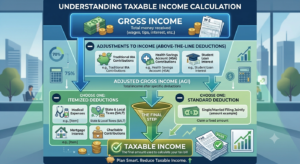
Your taxable income (what actually gets taxed) equals your gross income minus deductions and exemptions. The more you can legally reduce your taxable income, the lower your tax burden.
15 Legal Strategies to Reduce Your Tax Burden in 2024
1. Maximize Retirement Account Contributions
One of the most powerful tax reduction strategies is contributing to tax-advantaged retirement accounts.
401(k) Contributions
For 2024, you can contribute up to $23,000 to a traditional 401(k) ($30,500 if you’re 50 or older). These contributions are pre-tax, meaning they reduce your taxable income dollar-for-dollar.
Real-world example: If you earn $75,000 and contribute $15,000 to your 401(k), your taxable income drops to $60,000. If you’re in the 22% tax bracket, that’s an immediate tax savings of $3,300.
Traditional IRA Contributions
You can contribute up to $7,000 to a traditional IRA in 2024 ($8,000 if 50+), which may be tax-deductible depending on your income and whether you’re covered by a workplace retirement plan.
SEP IRA for Self-Employed
Self-employed individuals can contribute up to 25% of their net self-employment earnings or $66,000 (whichever is less) to a SEP IRA, dramatically reducing taxable income.
For more detailed information on retirement account options, check our guide: Tax-Advantaged Retirement Accounts: Maximizing Your Savings
2. Take Advantage of Health Savings Accounts (HSAs)
HSAs offer a rare “triple tax advantage” that makes them one of the best tax-reduction tools available.
Triple tax benefits:
- Contributions are tax-deductible
- Growth is tax-free
- Withdrawals for qualified medical expenses are tax-free
2024 Contribution Limits:
- Individual coverage: $4,150
- Family coverage: $8,300
- Additional $1,000 catch-up contribution if 55+
Strategic approach: If you can afford it, pay medical expenses out-of-pocket and let your HSA grow as an additional retirement account. After age 65, you can withdraw HSA funds for any purpose (taxed as regular income, like a traditional IRA).
To understand the difference between HSAs and FSAs, read: HSA vs FSA: Which Health Savings Account Is Right for You?
3. Claim All Available Tax Credits
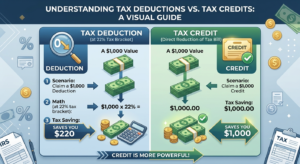
Tax credits are more valuable than deductions because they reduce your tax bill dollar-for-dollar rather than just reducing taxable income.
Major tax credits for 2024:
Earned Income Tax Credit (EITC): Worth up to $7,430 for families with three or more children. Even workers without children may qualify for up to $600.
Child Tax Credit: Up to $2,000 per qualifying child under 17. Partially refundable up to $1,600.
Child and Dependent Care Credit: 20-35% of up to $3,000 in care expenses for one dependent or $6,000 for two or more.
Lifetime Learning Credit: Up to $2,000 per tax return for qualified education expenses.
American Opportunity Credit: Up to $2,500 per eligible student for the first four years of higher education.
Residential Clean Energy Credit: 30% of the cost of installing solar panels, solar water heaters, wind turbines, or geothermal heat pumps.
Electric Vehicle Credit: Up to $7,500 for qualifying new electric vehicles purchased in 2024.
4. Strategic Charitable Giving
Charitable donations can reduce your taxable income while supporting causes you care about—but only if you itemize deductions.
Optimization strategies:
Bunching donations: Instead of donating $5,000 annually, consider donating $15,000 every three years to exceed the standard deduction threshold and itemize.
Donate appreciated assets: Donating stocks or crypto that have increased in value allows you to deduct the full market value while avoiding capital gains tax.
Donor-Advised Funds (DAFs): Contribute to a DAF for an immediate tax deduction, then distribute the funds to charities over several years.
Qualified Charitable Distributions (QCDs): If you’re 70½ or older, you can transfer up to $105,000 directly from your IRA to charity, satisfying Required Minimum Distributions without increasing taxable income.
Documentation requirements: Always get written acknowledgment for donations over $250, and keep detailed records of all charitable giving.
5. Harvest Tax Losses from Investments
Tax-loss harvesting involves selling investments that have decreased in value to offset capital gains from profitable investments.
How it works:
- Identify investments in your portfolio that are worth less than you paid
- Sell those investments to realize the loss
- Use losses to offset capital gains (and up to $3,000 of ordinary income)
- Carry forward unused losses to future tax years
Important rule: The “wash sale” rule prohibits buying the same or substantially identical security within 30 days before or after the sale. Violating this rule disallows the loss.
Strategic tip: Consider tax-loss harvesting in down markets or at year-end when you can assess your overall tax situation.
6. Maximize Business Deductions for Self-Employed Individuals
If you’re self-employed or have a side business, you have access to numerous deductions that W-2 employees don’t.
Common self-employment deductions:
Home office deduction: If you use part of your home exclusively and regularly for business, you can deduct related expenses. Use either the simplified method ($5 per square foot up to 300 sq ft) or actual expense method.
Business vehicle expenses: Track mileage (67 cents per mile for 2024) or actual expenses including gas, maintenance, insurance, and depreciation.
Equipment and supplies: Computers, software, office supplies, and business equipment are fully deductible.
Professional services: Legal fees, accounting services, and consulting fees related to your business.
Marketing and advertising: Website costs, business cards, online ads, and promotional materials.
Education and training: Courses, books, and conferences that improve your professional skills.
Section 179 deduction: Immediately expense up to $1,220,000 in qualifying business equipment purchases (rather than depreciating over time).
For comprehensive guidance on self-employment taxes and deductions, see: Self-Employed Tax Guide: Write-Offs and Deductions You’re Missing
7. Time Your Income and Expenses Strategically
When you earn income and when you pay deductible expenses can significantly impact your tax burden, especially if you expect to be in a different tax bracket next year.
If you expect higher income next year:
- Accelerate income into the current year
- Defer deductible expenses to next year when they’ll offset higher-taxed income
If you expect lower income next year:
- Defer income to next year when you’ll be in a lower bracket
- Accelerate deductible expenses into the current year
Practical applications:
- Ask for your year-end bonus in January instead of December
- Make January’s mortgage payment in December for an extra deduction
- Prepay property taxes or estimated state taxes before year-end
- Bill clients in early January instead of late December
Important consideration: The Tax Cuts and Jobs Act capped state and local tax (SALT) deductions at $10,000, so prepaying may not benefit everyone.
8. Contribute to a 529 Education Savings Plan
While 529 plan contributions aren’t federally tax-deductible, many states offer state income tax deductions or credits for contributions.
State tax benefits: Over 30 states offer tax deductions for 529 contributions, with some allowing deductions of $10,000 or more per beneficiary.
Federal benefits:
- Earnings grow tax-free
- Withdrawals for qualified education expenses are tax-free
- Can be used for K-12 tuition (up to $10,000 per year) and college expenses
- Recent changes allow up to $10,000 for student loan repayment
Bonus strategy: Some states allow deductions for contributions to any state’s 529 plan, not just your own state’s plan, allowing you to choose plans with better investment options.
9. Take the Home Office Deduction
Whether you’re self-employed or a W-2 employee working remotely, the home office deduction can provide substantial savings—though rules changed significantly after 2017.
For self-employed individuals:
You can still claim the home office deduction if you use a portion of your home exclusively and regularly as:
- Your principal place of business, OR
- A place where you meet clients or customers, OR
- A separate structure used for business
Two calculation methods:
Simplified method: $5 per square foot of home office space (maximum 300 square feet = $1,500 deduction)
Regular method: Calculate the percentage of your home used for business and deduct that percentage of:
- Mortgage interest or rent
- Property taxes
- Utilities
- Homeowners insurance
- Repairs and maintenance
- Depreciation
For W-2 employees: Unfortunately, the Tax Cuts and Jobs Act eliminated the home office deduction for employees through 2025, even if your employer requires you to work from home.

10. Consider a Flexible Spending Account (FSA)
FSAs allow you to set aside pre-tax money for medical expenses or dependent care, reducing your taxable income.
Healthcare FSA:
- 2024 limit: $3,200
- Use for copays, prescriptions, dental, vision, and many over-the-counter items
- “Use-it-or-lose-it” rule applies (though many plans allow $640 rollover or 2.5-month grace period)
Dependent Care FSA:
- 2024 limit: $5,000 per household
- Use for daycare, preschool, before/after school care, and summer camps
- Available for children under 13 or disabled dependents
Strategic planning: Carefully estimate your expenses because unused funds are typically forfeited. Review past medical and childcare costs to make informed contributions.
Learn more about choosing between accounts: HSA vs FSA: Which Health Savings Account Is Right for You?
11. Invest in Tax-Efficient Index Funds and ETFs
How you invest matters almost as much as what you invest in when it comes to taxes.
Tax-efficient investment strategies:
Index funds and ETFs: These passively managed funds have lower turnover rates, generating fewer taxable capital gains distributions compared to actively managed funds.
Asset location optimization:
- Hold tax-inefficient investments (bonds, REITs, actively managed funds) in tax-advantaged accounts
- Hold tax-efficient investments (index funds, growth stocks) in taxable accounts
Tax-managed funds: Some funds specifically aim to minimize taxable distributions through strategies like tax-loss harvesting and avoiding short-term gains.
Hold investments long-term: Gains on investments held over one year qualify for preferential long-term capital gains rates (0%, 15%, or 20%) instead of ordinary income rates (up to 37%).
Avoid mutual fund purchases near year-end: You may receive taxable capital gains distributions even if you just bought the fund.
12. Claim Above-the-Line Deductions
Above-the-line deductions (adjustments to income) reduce your Adjusted Gross Income (AGI) and are available whether you itemize or take the standard deduction.
Valuable above-the-line deductions for 2024:
Student loan interest: Deduct up to $2,500 of student loan interest paid, subject to income limitations.
Educator expenses: Teachers and educators can deduct up to $300 of unreimbursed classroom expenses.
Self-employment tax: Deduct half of your self-employment tax.
Self-employed health insurance: Deduct premiums you paid for medical, dental, and long-term care insurance for yourself and family.
Alimony paid: For divorce agreements executed before 2019.
IRA contributions: Traditional IRA contributions may be deductible depending on income and retirement plan coverage.
Health Savings Account contributions: As discussed earlier, fully deductible.
These deductions are particularly valuable because they reduce your AGI, which can help you qualify for other tax benefits that have AGI thresholds.
13. Optimize Your Filing Status and Dependents
Your filing status can significantly impact your tax burden, and in some cases, you have options.
Filing status considerations:
Married Filing Jointly vs. Separately: Joint filing usually results in lower taxes, but running the numbers both ways can reveal exceptions, especially when one spouse has high medical expenses or miscellaneous deductions.
Head of Household: If you’re unmarried and pay more than half the cost of maintaining a home for yourself and a qualifying dependent, this status offers better rates than single filing.
Qualifying Widow(er): Allows you to use joint filing rates for two years after a spouse’s death if you have a dependent child.
Dependency claims:
Ensure you’re claiming all eligible dependents. A qualifying child or relative can provide valuable tax benefits:
- Child Tax Credit ($2,000)
- Additional exemption amount
- Dependent Care Credit eligibility
- Head of Household filing status
Important: If you’re divorced or separated, the custodial parent generally claims the child unless they sign Form 8332 releasing the claim to the noncustodial parent.
14. Make Energy-Efficient Home Improvements
The Inflation Reduction Act expanded tax credits for energy-efficient home improvements, providing significant savings opportunities.
Residential Clean Energy Credit (25D):
- 30% credit for solar panels, solar water heaters, wind turbines, geothermal heat pumps, and fuel cells
- No annual or lifetime dollar limit
- Available through 2032 (then phases down)
Energy Efficient Home Improvement Credit (25C):
- 30% credit up to annual limits for qualifying improvements
- Exterior doors, windows, skylights ($600 credit limit)
- Central A/C, heat pumps, water heaters, biomass stoves
- Home energy audits ($150 credit)
- Annual limit: $1,200 for most improvements ($2,000 for heat pumps)
Strategic timing: Plan major improvements to maximize the annual credit limits over multiple years.

15. Consider Municipal Bonds for Tax-Free Income
Municipal bonds (munis) pay interest that’s exempt from federal income tax and often state and local taxes if you live in the issuing state.
When munis make sense:
Higher tax brackets benefit most: If you’re in the 32% federal bracket or higher, tax-free municipal bond yields become very attractive compared to taxable bonds.
Tax-equivalent yield calculation:
Tax-Equivalent Yield = Municipal Bond Yield ÷ (1 – Your Tax Rate)
Example: A 3.5% municipal bond is equivalent to a 5.15% taxable bond if you’re in the 32% tax bracket (3.5% ÷ 0.68 = 5.15%).
Considerations:
- Generally lower yields than taxable bonds
- Credit risk varies (highly rated munis are quite safe)
- Better suited for taxable accounts (wasted in IRAs/401(k)s)
- Alternative Minimum Tax (AMT) may apply to some private activity bonds
Where to invest: Individual municipal bonds, municipal bond funds, or municipal bond ETFs all provide access to tax-free income.
Additional Tax Planning Strategies Worth Considering
Roth Conversions in Low-Income Years
If you have a year with unusually low income (career transition, sabbatical, early retirement), consider converting traditional IRA funds to a Roth IRA.
Benefits:
- Pay tax now at a lower rate
- Future growth and withdrawals are tax-free
- No Required Minimum Distributions (RMDs)
- Tax-free inheritance for beneficiaries
Strategy: Convert enough to “fill up” your current tax bracket without jumping to the next one.
Bunching Medical Expenses
Medical expenses are only deductible to the extent they exceed 7.5% of your AGI, making them difficult to claim.
Bunching strategy: If you’re close to the threshold, try to time elective medical procedures, dental work, and other healthcare expenses into the same year to exceed the 7.5% floor.
Qualified expenses include:
- Doctor visits, surgeries, prescriptions
- Dental and vision care
- Medical equipment and supplies
- Long-term care insurance premiums (limited)
- Mileage to medical appointments (21 cents per mile in 2024)
Maximize Business Use of Your Vehicle
If you use your car for business, proper documentation can yield substantial deductions.
Two methods:
Standard mileage rate: 67 cents per mile in 2024 (simple but still valuable)
Actual expense method: Track all vehicle costs (gas, insurance, repairs, depreciation) and deduct the business-use percentage
Requirements:
- Keep a mileage log showing date, destination, business purpose, and miles
- Commuting to your regular workplace doesn’t count
- Driving between job sites, to client meetings, and for business errands all qualify
Self-employed advantage: W-2 employees can no longer deduct unreimbursed business mileage (eliminated 2018-2025), but self-employed individuals still can.
Common Tax Reduction Mistakes to Avoid
Overlooking the Standard Deduction
For 2024, the standard deduction is:
- $14,600 for single filers
- $29,200 for married filing jointly
- $21,900 for head of household
Mistake: Keeping poor records of deductible expenses, then defaulting to the standard deduction when itemizing would have been better.
Solution: Track potentially deductible expenses throughout the year, then compare total itemized deductions to the standard deduction at tax time.
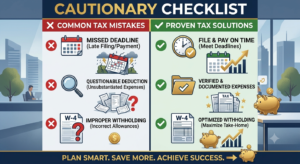
Claiming Questionable Deductions
Mistake: Aggressively claiming deductions that don’t truly qualify, hoping the IRS won’t notice.
Consequences: Audits, penalties, interest, and potential criminal prosecution for fraud.
Solution: Only claim legitimate deductions you can document. When in doubt, consult a tax professional.
Missing Deadlines
Mistake: Failing to make contributions or payments by required deadlines.
Important deadlines:
- December 31: Most retirement contributions, charitable donations, property tax prepayments
- Tax filing deadline (April 15, typically): IRA contributions, HSA contributions
- Throughout the year: Estimated tax payments for self-employed
Solution: Set calendar reminders for important tax deadlines, especially for year-end planning moves.
Not Adjusting Withholding or Estimated Taxes
Mistake: Having too much or too little withheld from paychecks or not making adequate estimated tax payments.
Consequences:
- Over-withholding: Giving the government an interest-free loan
- Under-withholding: Penalties and interest charges
Solution: Review your W-4 annually and adjust withholding to match your expected tax liability. Self-employed individuals should make quarterly estimated payments.
Forgetting State Tax Implications
Mistake: Focusing solely on federal taxes while ignoring state tax opportunities.
Strategy: Research your state’s specific deductions and credits, which may include:
- 529 plan contribution deductions
- Energy efficiency credits
- First-time homebuyer credits
- Property tax rebates or credits
Working with Tax Professionals
When to Hire a Tax Professional
Consider professional help if you:
- Are self-employed with complex business deductions
- Have significant investment income or rental properties
- Experienced major life changes (marriage, divorce, inheritance)
- Live or work in multiple states
- Have international income or accounts
- Are being audited or received IRS notices
- Simply want peace of mind and optimization
Types of Tax Professionals
Certified Public Accountant (CPA): Licensed professionals who can represent you before the IRS and provide comprehensive tax planning.
Enrolled Agent (EA): Federally licensed tax practitioners who specialize in taxation and can represent you before the IRS.
Tax Attorney: Lawyers specializing in tax law, best for complex legal issues, estate planning, or serious IRS disputes.
Tax Preparation Services: Companies like H&R Block or Jackson Hewitt offer varying levels of service from DIY software to full-service preparation.
Cost consideration: While professional help costs $200-$500+ for basic returns (more for complex situations), the tax savings and peace of mind often far exceed the cost.
Tax Planning Calendar: Year-Round Tax Reduction
January – March
- Gather tax documents and receipts
- Make prior-year IRA contributions (before April deadline)
- Review prior year and identify tax-reduction opportunities for current year
- Make first-quarter estimated tax payment (if self-employed)
April – June
- File tax return or extension
- Adjust W-4 withholding if needed based on prior year results
- Make second-quarter estimated tax payment (if self-employed)
- Review retirement contributions and consider increasing
July – September
- Mid-year tax projection to avoid surprises
- Make third-quarter estimated tax payment (if self-employed)
- Consider tax-loss harvesting if markets are down
- Review charitable giving plans
October – December
- Year-end tax planning is crucial
- Maximize retirement account contributions
- Make charitable donations before December 31
- Harvest tax losses
- Prepay January expenses with tax benefits (if beneficial)
- Make fourth-quarter estimated tax payment (if self-employed)
- Review and purchase any equipment for Section 179 deduction
Pro tip: Don’t wait until December to think about taxes. Year-round planning is significantly more effective than last-minute scrambling.
Tax Software and Tools
Best Tax Software for 2024
For simple returns:
- TurboTax Free Edition – Good interface, guided process
- Cash App Taxes – Completely free for all federal and state returns
- FreeTaxUSA – Free federal, low-cost state returns
For complex returns:
- TurboTax Premier or Self-Employed – Comprehensive features, excellent support
- H&R Block Premium – Strong for itemizers and investors
- TaxAct – More affordable with similar features
Expense tracking apps:
- QuickBooks Self-Employed – Excellent for tracking business deductions
- Expensify – Great for receipt scanning and categorization
- MileIQ – Automatic mileage tracking
Free IRS Resources
- IRS Free File: Free software options if you earn under $79,000
- IRS Withholding Calculator: Optimize your W-4 withholding
- IRS Publication 17: Your complete federal tax guide
- IRS.gov: Tax forms, instructions, and guidance
Frequently Asked Questions
Is tax avoidance legal?
Yes, absolutely. Tax avoidance means using legal methods within the tax code to minimize your tax burden. This is different from tax evasion (illegally hiding income or falsifying deductions), which is a crime. Every taxpayer has the right to arrange their finances to pay the least amount of tax legally required.
How much can I realistically save with these strategies?
Savings vary dramatically based on income, filing status, and which strategies apply to your situation. A middle-income family might save $2,000-$5,000 annually through proper use of retirement accounts, HSAs, and tax credits. Higher earners implementing multiple strategies could save $10,000-$30,000 or more.
Should I itemize or take the standard deduction?
Calculate both. Add up all your itemizable deductions (mortgage interest, property taxes up to $10,000, charitable contributions, medical expenses over 7.5% of AGI). If this total exceeds your standard deduction ($14,600 single, $29,200 married filing jointly for 2024), itemize. Otherwise, take the standard deduction.
For more information on maximizing deductions, see: Tax Deductions Everyone Should Know: Complete Guide for Beginners
Can I deduct my home office if I’m a W-2 employee?
Unfortunately, no. The Tax Cuts and Jobs Act eliminated the home office deduction for W-2 employees from 2018 through 2025, even if your employer requires you to work from home. Only self-employed individuals can claim this deduction currently.
What happens if I’m audited?
Remain calm. Most audits are correspondence audits (handled by mail) that request documentation for specific items. Respond promptly with clear documentation. If you used a tax professional to prepare your return, contact them immediately. You have the right to representation. Most audits result from simple mistakes or missing documentation, not fraud.
Should I pay off my mortgage to save on taxes?
This is a common misconception. While mortgage interest is deductible (if you itemize), you shouldn’t keep a mortgage solely for the tax deduction. For every dollar of interest you pay, you might save 22-37 cents in taxes, but you’re still paying 63-78 cents. Pay off high-interest debt first, but don’t rush to eliminate a low-interest mortgage if you can invest the money for higher returns elsewhere.
Other ideas
https://trendminers.online/tax-deductions-everyone-should-know-in-2026/
https://trendminers.online/hsa-vs-fsa/
https://trendminers.online/tax-advantaged-retirement-accounts/
https://trendminers.online/self-employed-tax-guide/
Conclusion: Your Tax Reduction Action Plan
Reducing your tax burden legally isn’t about finding loopholes or taking risks—it’s about understanding the tax code and using available strategies to your advantage.
Your immediate action steps:
✓ This month: Review your current withholding and adjust if needed to avoid owing or over-refunding
✓ Before year-end: Maximize retirement account contributions and consider year-end tax moves
✓ Ongoing: Track deductible expenses throughout the year, not just at tax time
✓ Annually: Meet with a tax professional to review your situation and plan for the coming year
✓ Long-term: Implement tax-efficient investment strategies and retirement planning
Remember the key principles:
- Tax planning is year-round, not just a once-a-year activity
- Documentation is crucial—keep excellent records
- When in doubt, consult a qualified tax professional
- Legal tax reduction is your right as a taxpayer
- Small optimizations compound over time into substantial savings
The difference between paying your fair share and paying more than required often comes down to knowledge and planning. By implementing even a few of the strategies outlined in this guide, you can keep more of your hard-earned money working for you instead of unnecessarily flowing to the government.
Continue your financial education:
- Discover overlooked deductions: Tax Deductions Everyone Should Know: Complete Guide for Beginners
- Self-employed? Learn more: Self-Employed Tax Guide: Write-Offs and Deductions You’re Missing
- Compare account options: HSA vs FSA: Which Health Savings Account Is Right for You?
- Optimize retirement savings: Tax-Advantaged Retirement Accounts: Maximizing Your Savings