
Introduction
Being your own boss comes with incredible perks—flexibility, unlimited earning potential, and the ability to build something uniquely yours. But it also comes with a heavy tax burden. Unlike traditional W-2 employees, self-employed individuals bear the full weight of their taxes, including both the employer and employee halves of Medicare and Social Security.
However, the tax code also offers a massive advantage to the self-employed: the ability to deduct business expenses before calculating your tax liability. The problem? Most freelancers, independent contractors, and small business owners leave thousands of dollars on the table every year simply because they don’t know what they can legally deduct.
Did you know that missing just $2,000 in legitimate write-offs could cost you over $600 in self-employment tax alone, plus additional income tax? Over a decade, that compounds into a significant loss of wealth.
Whether you drive for a rideshare app, run a freelance design business, consult, or operate a local service business, this comprehensive self-employed tax guide will walk you through the deductions you’re likely missing. We’ll go beyond the obvious office supplies and uncover the hidden write-offs that can drastically lower your tax bill in 2024.
https://trendminers.online/how-to-reduce-your-tax-burden-legally/
For a broader look at lowering your overall tax burden, be sure to check out our guide: How to Reduce Your Tax Burden Legally: 15 Smart Strategies for 2024
The Self-Employment Tax Landscape in 2026
Before diving into specific write-offs, it’s vital to understand how self-employment taxes work. When you’re self-employed, you face two main types of taxes:
1. Self-Employment (SE) Tax: Currently 15.3% on your net earnings. This covers your Social Security (12.4%) and Medicare (2.9%) contributions. As an employee, your employer pays half of this, but as your own boss, you pay both halves.
2. Income Tax: Ranging from 10% to 37% depending on your total taxable income and filing status.
The Silver Lining: You only pay SE tax and income tax on your net business income, not your gross revenue.
Gross Revenue minus Business Deductions = Net Business Income.
This is why maximizing your deductions is critical. Every legitimate expense you deduct not only lowers your income tax but also reduces your 15.3% self-employment tax.
The Employer-Equivalent Deduction: As a bonus, the IRS allows you to deduct half of your total self-employment tax from your gross income. This is an above-the-line deduction, meaning you get it whether you itemize or take the standard deduction. (For more above-the-line strategies, read: Tax Deductions Everyone Should Know: Complete Guide for Beginners).
The Golden Rule of Business Deductions
The IRS has a specific rule governing what can and cannot be deducted. According to IRS Section 162, a business expense must be both “ordinary and necessary.”
Ordinary: Common and accepted in your specific trade or industry.
Necessary: Helpful and appropriate for your business, though it doesn’t have to be indispensable.
This means a freelance graphic designer can easily deduct Adobe Creative Cloud software (ordinary and necessary), but a freelance writer would have a hard time deducting a $3,000 commercial welding machine (neither ordinary nor necessary for that trade).
If an expense serves both a personal and business purpose, you can only deduct the business portion. This requires careful allocation, which brings us to the most commonly missed deductions.
Top Write-Offs Self-Employed Individuals Miss
The Home Office Deduction (Done Right)
The home office deduction is notoriously misunderstood. Many self-employed individuals avoid it, fearing it’s an automatic audit trigger. In reality, if you follow the rules, it’s one of your most lucrative deductions.
The Strict Rule: You must use a specific portion of your home exclusively and regularly for your business. “Exclusively” means you cannot use this space for personal purposes. A spare bedroom used solely as your office qualifies; your kitchen table where you sometimes work does not.
Two Calculation Methods:
The Simplified Method: You deduct $5 per square foot of your home office, up to a maximum of 300 square feet (capping the deduction at $1,500). It requires minimal record-keeping but offers a smaller deduction.
The Regular Method: You calculate the actual expenses of your home and deduct the percentage used for business.
- Calculate your office square footage divided by total home square footage = Business Use Percentage.
- Apply this percentage to your rent (or mortgage interest and property taxes), utilities, homeowners insurance, HOA fees, and general home repairs.
- You can also deduct depreciation on the home.
The regular method requires more math and receipt-saving, but it almost always yields a much higher deduction. If your home office is 15% of your home, and your annual housing costs are $24,000, that’s a $3,600 deduction—more than double the simplified method.
Vehicle and Transportation Deductions
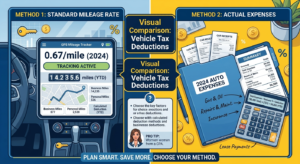
If you drive for business, you are missing out on serious cash if you aren’t tracking mileage. You have two options for writing off vehicle expenses:
Standard Mileage Rate: For 2026, the IRS rate is 67 cents per business mile. This rate factors in gas, insurance, maintenance, and depreciation. You just need a detailed mileage log.
Actual Expense Method: You track all actual costs of operating the vehicle (gas, oil changes, repairs, insurance, registration, depreciation) and multiply by your business-use percentage.
What counts as business mileage?
- Driving from your home office to a client’s office
- Driving to the store to buy office supplies
- Driving between multiple job sites
What does NOT count?
- Commuting from home to your regular workplace (if you rent an office elsewhere). However, if your home office is your principal place of business, driving from home to another business location is deductible.
Pro Tip: Use a GPS mileage tracking app like MileIQ or TripLog. Trying to reconstruct a year’s worth of mileage from memory at tax time is nearly impossible and won’t hold up in an audit.
Health Insurance Premiums
If you are self-employed and not eligible for an employer-sponsored health plan (through a spouse’s job, for example), you can deduct 100% of your health insurance premiums for yourself, your spouse, and your dependents.
This is an above-the-line deduction, meaning it reduces your Adjusted Gross Income (AGI).
What qualifies:
- Medical, dental, and qualified long-term care insurance premiums
- Medicare Part B and Part D premiums (if you are 65+ and self-employed)
- Medicare Advantage premiums
Important limitation: You cannot deduct more than your net self-employment income. If your business loses money, you cannot claim this deduction for that year.
Note: You cannot deduct premiums that were paid with pre-tax dollars through an employer’s plan, nor can you deduct premiums paid through a Health Care Marketplace if you received a subsidy (Advance Premium Tax Credit) for those same premiums. You can only deduct the out-of-pocket portion you actually paid.
To further optimize your healthcare tax strategy, see our guide: HSA vs FSA: Which Health Savings Account Is Right for You?
Technology, Software, and Subscriptions
In today’s digital economy, software is the lifeblood of a freelance or self-employed business. Yet, many entrepreneurs only deduct the obvious ones and forget the smaller monthly subscriptions.
Fully deductible tech expenses include:
- Laptops, tablets, and smartphones (if used primarily for business; otherwise, deduct the business-use percentage)
- Adobe Creative Cloud, Microsoft 365, or industry-specific software
- Website hosting and domain registration fees
- Cloud storage (Google Drive, Dropbox)
- Accounting software (QuickBooks, FreshBooks, Wave)
- Project management tools (Asana, Trello, Monday.com)
- Communication tools (Zoom Pro, Slack, VoIP business phone lines)
The “SaaS creep” warning: Review your monthly subscriptions annually. If you are paying for software you no longer use, cancel it—but make sure you deduct the months you did pay for it on your taxes.
Continuing Education and Professional Development
The IRS allows you to deduct education expenses, but the rules are strict. The education must either:
- Maintain or improve skills needed in your current business, OR
- Be required by law or regulation to keep your current license or status.
What you CAN deduct:
- Online courses, workshops, and seminars related to your current field
- Professional certification renewals
- Trade magazine and journal subscriptions
- Books and manuals directly related to your business operations
What you CANNOT deduct:
- Education that qualifies you for a new trade or business. (e.g., A freelance writer cannot deduct the cost of going to nursing school. But a freelance writer can deduct a course on advanced SEO copywriting.)
Retirement Contributions for the Self-Employed
Retirement contributions are arguably the most powerful tax shelter available to the self-employed. Not only do you save for your future, but you also drastically reduce your current tax liability.
SEP IRA (Simplified Employee Pension): You can contribute up to 25% of your net self-employment earnings, with a maximum of $69,000 in 2024. Easy to set up and requires minimal administration.
Solo 401(k): Designed for business owners with no full-time employees (other than a spouse). You can contribute both as an “employee” (up to $23,000 in 2024) and as an “employer” (up to 25% of compensation), with a total cap of $69,000. This allows for massive contributions even with lower income levels.
Defined Benefit Plan: For high-earning solopreneurs, this allows for extremely large contributions (often $200,000+) but requires an actuary to manage.
By maxing out a Solo 401(k) or SEP IRA, you can legally shield tens of thousands of dollars from income tax, and in some cases, reduce your net profit enough to lower your tax bracket entirely.
To dive deeper into this strategy, read: Tax-Advantaged Retirement Accounts: Maximizing Your Savings
Meals and Entertainment (The 50% Rule)
The rules around business meals changed recently, and it’s crucial to get them right.
Standard Business Meals (50% deductible): If you have a business meeting over lunch with a client, vendor, or partner, you can deduct 50% of the cost. The meal cannot be lavish, and you (the business owner) must be present. You must also keep documentation of the date, amount, location, business purpose, and who you met with.
Meals While Traveling (50% deductible): When traveling overnight for business, your meals are 50% deductible. You can track actual costs or use the standard GSA per diem rates for the city you are visiting.
Office Snacks and Parties (100% deductible): Food provided to employees on the business premises for the convenience of the employer, or office holiday parties and company picnics, are 100% deductible. (Note: If you are a sole proprietor with no employees, deducting groceries as “office snacks” is highly scrutinized and generally not allowed).
Entertainment (0% deductible): Taking a client to a golf course, a concert, or a sporting event is no longer deductible under the Tax Cuts and Jobs Act. Even if you discuss business right before the event, the entertainment cost itself cannot be written off (though a meal consumed during the event might still be 50% deductible if itemized separately).
https://trendminers.online/hsa-vs-fsa/
Business Use of Your Phone and Internet
If you use your personal cell phone and home internet for business, you are missing out on deductions if you aren’t writing off the business portion.
How to calculate: Look at your usage objectively. If you use your phone 60% of the time for client calls, emails, and business apps, and 40% for personal use, deduct 60% of your monthly phone bill.
The same applies to your internet bill. Track the percentage of time you use the internet for business vs. personal browsing or streaming.
Documentation: Review a couple of months of usage to establish a defensible percentage. Keep your monthly bills as proof of the expense.

The 20% Qualified Business Income (QBI) Deduction
We cannot discuss self-employed taxes without mentioning the Qualified Business Income (QBI) deduction, also known as Section 199A. This is one of the most generous tax breaks for small business owners, yet many fail to optimize for it.
What it is: The QBI deduction allows eligible self-employed individuals and small business owners to deduct up to 20% of their qualified business income from their taxes.
Why it’s amazing: It is an above-the-line deduction, meaning you don’t need to itemize to get it. It effectively lowers your tax rate on business income by 20%.
Example: If your net business income is $80,000, you could potentially deduct $16,000 from your taxable income. At a 22% tax bracket, that saves you $3,520 in taxes.
Income Limitations for 2026:
For sole proprietors and single-member LLCs providing service-based businesses (health, law, accounting, consulting, financial services, etc.), the QBI deduction begins to phase out at $191,950 of taxable income for single filers and $383,900 for married filing jointly.
If your income is below these thresholds, you generally get the full 20% deduction automatically. If you are above them, the math becomes complex, involving W-2 wages paid and unadjusted basis of property.
The Strategy: Because QBI is based on your net business income, every deduction you take lowers your net income. While lowering income generally lowers taxes, you want to ensure you aren’t dropping your income so low that you miss out on other tax brackets or benefits, or conversely, if your income is too high for QBI, taking more deductions might help you fall under the threshold to qualify for it. Always consult a CPA if you are near the income thresholds.
Quarterly Estimated Taxes: Avoiding the Penalty Trap
One of the biggest shocks for new self-employed individuals is discovering they owe a massive tax bill in April—and a penalty on top of it.
Unlike W-2 employees who have taxes withheld from every paycheck, self-employed individuals must pay their taxes throughout the year via quarterly estimated payments.
Who must pay? If you expect to owe at least $1,000 in taxes for the year after subtracting withholding and credits, you must make quarterly payments.
The 4 Deadlines:
- April 15: Payment for Jan 1 – March 31
- June 15: Payment for April 1 – May 31
- September 15: Payment for June 1 – Aug 31
- January 15: Payment for Sept 1 – Dec 31 (of the previous year)
How to calculate what you owe:
You can use Form 1040-ES to estimate your tax. You will need to project your total income and expenses for the year, calculate your expected SE tax and income tax, and divide by four.
The Safe Harbor Rule: To avoid underpayment penalties, you just need to pay 100% of your previous year’s total tax liability (110% if your adjusted gross income was over $150,000), or 90% of the current year’s tax liability. If you meet either of these thresholds, the IRS won’t penalize you, even if you end up owing more at tax time.
Pro Tip: Open a separate high-yield savings account. Every time a client pays you, immediately transfer 25-30% of that payment into the savings account. When quarterly taxes come due, the money is sitting there waiting, and you’ve earned interest on it in the meantime.
Recordkeeping Best Practices to Survive an Audit
Claiming deductions is only half the battle. If you can’t prove the expenses in an audit, the IRS will disallow them, and you’ll owe back taxes plus penalties and interest.
1. Never Comingle Personal and Business Funds
The absolute most important step for a self-employed individual is to open a separate business checking account. All business income should go into this account, and all business expenses should be paid from it.
If you use a personal account, untangling business expenses from personal ones at tax time is a nightmare. Furthermore, commingling funds can pierce the “corporate veil” if you operate as an LLC, opening your personal assets to liability.
2. The “Contemporaneous” Mileage Log
The IRS hates hand-written mileage logs created at the end of the year. They want a “contemporaneous” log—meaning it was created at or near the time you drove. An automated app is the gold standard. If audited, a spreadsheet dated April 14th claiming to log miles from January 2nd will be immediately rejected.
3. Keep Receipts, Not Just Bank Statements
A bank or credit card statement proves you spent $150 at Best Buy. It does not prove what you bought. If you bought a monitor for your business, it’s deductible. If you bought a personal television, it is not. Keep the itemized receipt. Digital copies (photos taken with an app) are perfectly legal and preferred by the IRS over faded thermal paper.
4. Document the “Business Purpose”
For meals, travel, and entertainment-adjacent expenses, write the business purpose on the receipt before you file it. “Lunch with Sarah” is not enough. “Lunch with Sarah – discussed Q3 marketing campaign deliverables” proves it was a legitimate business expense.

https://trendminers.online/tax-advantaged-retirement-accounts/
Frequently Asked Questions
Can I deduct the clothes I buy for work?
Generally, no. The IRS requires clothing to be both not suitable for everyday wear and required as a condition of your employment to be deductible. A business suit can be worn to a wedding, so it’s not deductible. However, specialized safety gear, uniforms with a company logo, and theatrical costumes for performers are deductible.
I lost money this year. Do I still have to pay self-employment tax?
If your business expenses exceed your business income, you have a net loss. You do not owe self-employment tax on a net loss. Furthermore, you can use that net loss to offset other income (like a spouse’s W-2 wages or investment income), reducing your overall tax bill. However, you must be able to prove you were operating with a profit motive. If the IRS declares your business a “hobby,” your deductions will be severely limited.
Can I deduct the fees I pay to my accountant?
Yes! Fees paid to a CPA, tax preparer, or bookkeeper for services related to your business are fully deductible business expenses. If they handle both your personal and business taxes, you can deduct the portion of their fee attributed to your business (Schedule C preparation).
What is the Section 179 deduction?
Section 179 allows you to take the full purchase price of qualifying equipment or software and deduct it in the year you buy it, rather than depreciating it over several years. For 2024, the limit is $1.22 million. If you buy a $3,000 computer for your business, you can deduct the entire $3,000 this year instead of spreading it out over 5 years.
Do I need an LLC to get these deductions?
No. Your tax status is separate from your legal entity status. By default, a single-member LLC is taxed as a sole proprietorship, meaning you file a Schedule C just like a freelancer without an LLC. The deductions are identical. An LLC provides legal liability protection, not necessarily tax advantages (until you elect to be taxed as an S-Corp, which is a different strategy).
Conclusion: Stop Leaving Money on the Table
Navigating self-employment taxes can feel overwhelming, but mastering your deductions is the fastest way to increase your take-home pay without having to work more hours.
Your Action Plan:
- Open a dedicated business checking account today if you haven’t already.
- Download a mileage tracking app and start logging business drives.
- Review your monthly subscriptions and identify the business-use percentages of your phone and internet.
- Work with a CPA to determine if a SEP IRA or Solo 401(k) is right for you.
- Set aside 25-30% of every client payment for quarterly estimated taxes.
By taking a proactive approach to your tax strategy, you transform taxes from a source of stress into an optimized system for wealth retention. Don’t guess when it comes to your hard-earned money. Track everything, deduct what is ordinary and necessary, and consult a professional when things get complex.
Ready to optimize your entire financial life? Continue reading:
- Maximize every angle of your tax strategy: How to Reduce Your Tax Burden Legally: 15 Smart Strategies for 2026
- Discover deductions available to all taxpayers: Tax Deductions Everyone Should Know: Complete Guide for Beginners
- Choose the right health tax shelter: HSA vs FSA: Which Health Savings Account Is Right for You?
- Secure your future while cutting taxes: Tax-Advantaged Retirement Accounts: Maximizing Your Savings