Introduction
Healthcare costs continue to rise, and navigating the various accounts designed to help you pay for medical expenses can feel overwhelming. Two of the most common options offered through employers are Health Savings Accounts (HSAs) and Flexible Spending Accounts (FSAs). While both allow you to set aside pre-tax money for healthcare expenses, they operate very differently and serve different needs.
Choosing between an HSA and an FSA isn’t just a health insurance decision—it’s a financial decision with significant implications for your taxes, savings, and long-term wealth building.
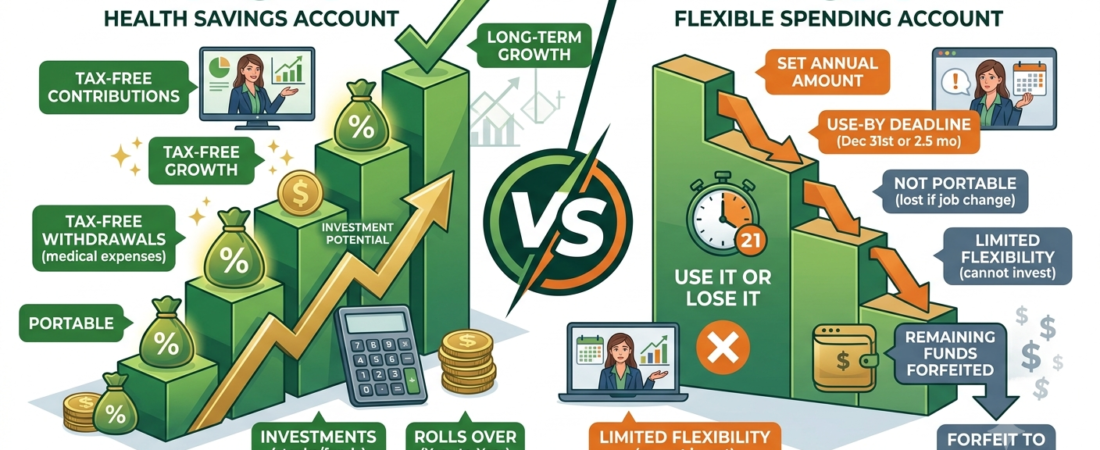
The HSA is often called the “ultimate retirement account” by financial experts because of its rare triple tax advantage. The FSA, meanwhile, provides a simpler way to save on taxes for predictable medical expenses but comes with a frustrating “use it or lose it” limitation.
https://trendminers.online/how-to-reduce-your-tax-burden-legally/
In this comprehensive guide, you’ll learn exactly how each account works, their pros and cons, eligibility requirements, and strategies to maximize your healthcare savings. By the end, you’ll know precisely which account is right for your situation—and how to make the most of it.HSA vs FSA
What Is an HSA (Health Savings Account)?
A Health Savings Account is a tax-advantaged savings account that you can use to pay for qualified medical expenses. It’s designed to work in conjunction with a High-Deductible Health Plan (HDHP).
How an HSA works:
When you enroll in a qualifying HDHP, you become eligible to open an HSA. You (and/or your employer) can contribute pre-tax money to the account, which you then use to pay for qualified medical, dental, and vision expenses.
Key features of an HSA:
- You own the account: Unlike FSAs, HSAs are owned by you, not your employer. If you change jobs, the account goes with you.
- Money rolls over: Unused funds remain in your account year after year. There’s no “use it or lose it” penalty.
- Investment potential: Once your balance reaches a certain threshold (often $1,000-$2,000), you can invest the funds in mutual funds, ETFs, and other investment vehicles, allowing your healthcare savings to grow over time.
- Triple tax advantage: This is the HSA’s superpower.
2024 HSA Contribution Limits
- Individual coverage: $4,150 per year
- Family coverage: $8,300 per year
- Additional catch-up contribution: $1,000 more per year if you’re 55 or older
These limits apply to the combined contributions from you and your employer. If you have family coverage under an HDHP, your HSA limit is $8,300, regardless of how many family members are covered.
For 2025, the limits increase to:
- Individual: $4,300
- Family: $8,550
- Catch-up: $1,000
HDHP requirements for 2024:
- Minimum deductible: $1,600 (individual) or $3,200 (family)
- Maximum out-of-pocket expense limit: $8,050 (individual) or $16,100 (family)
What Is an FSA (Flexible Spending Account)?
A Flexible Spending Account, also called a Flexible Spending Arrangement, is an employer-sponsored benefit that allows you to set aside pre-tax dollars for qualified healthcare expenses.
How an FSA works:
During open enrollment, you elect an amount to contribute for the upcoming year (up to the IRS annual limit). Contributions are deducted equally from each paycheck on a pre-tax basis. You can then submit claims to be reimbursed for eligible medical expenses.
Key features of an FSA:
- Use it or lose it: Funds generally must be used within the plan year or you forfeit them. Some employers offer a grace period or carryover option (explained below).
- No investment growth: FSA funds are not invested—they’re simply a spending account for medical expenses.
- Employer-owned: Your FSA is tied to your employer. If you change jobs, you lose access to the account and any unused funds.
- Full amount available at plan start: Your entire elected contribution is available on day one, even though you haven’t contributed all of it yet. This is called “uniform coverage.”
2024 FSA Contribution Limits
- Healthcare FSA limit: $3,200 per year (up from $3,050 in 2023)
- Dependent Care FSA limit: $5,000 per year ($2,500 if married filing separately)
The healthcare FSA and dependent care FSA are separate accounts with separate limits. A dependent care FSA covers childcare expenses, while a healthcare FSA covers medical expenses.
For 2025, the healthcare FSA limit increases to $3,300.
Two types of FSAs:
Healthcare FSA: This is what most people mean when they say “FSA.” It covers medical, dental, vision, prescription, and many over-the-counter health expenses.
Dependent Care FSA: This covers childcare expenses for children under 13 or care for dependents who can’t care for themselves. The $5,000 limit is per household, meaning if both spouses have dependent care FSAs through their employers, their combined contributions can’t exceed $5,000.
HSA vs FSA: Key Differences at a Glance
Before diving into the details, here’s a quick comparison of the main differences:
| Feature | HSA | FSA |
|---|---|---|
| Eligibility | Must have a high-deductible health plan (HDHP) | Available to anyone with an employer offering it |
| Account ownership | You own it | Employer owns it |
| Portability | Stays with you if you change jobs | Lost when you change jobs |
| Funds roll over | Yes, indefinitely | Limited (see below) |
| Investment potential | Yes, can invest and grow | No, no investment options |
| Triple tax advantage | Yes | No (only pre-tax contributions) |
| Contribution limit (2024) | $4,150 individual / $8,300 family | $3,200 |
| Catch-up contributions (55+) | Yes, $1,000 extra | No |
| Available at plan start | No, must be in account first | Yes, full amount available |
| Maximum age for contributions | 65 and older can still use, cannot contribute once Medicare enrolled | No age limit (but employment-based) |
| Qualified expenses list | Broad, includes medical, dental, vision | Broad, but some differences (e.g., no over-the-counter without prescription until recent changes) |
HSA vs FSA: Detailed Comparison
Now let’s dive deeper into each area to understand the full picture.
Eligibility Requirements
HSA eligibility:
To contribute to an HSA, you must:
- Be enrolled in a qualifying High-Deductible Health Plan (HDHP)
- Not be enrolled in Medicare
- Not be claimed as a dependent on someone else’s tax return
- Not have disqualifying coverage (such as a general-purpose FSA or health plan that covers expenses before your deductible)
This last point is important: if you have a “general-purpose” FSA, you typically can’t contribute to an HSA because the FSA coverage would be considered disqualifying. However, many HDHPs are paired with a “limited-purpose” FSA that covers only dental, vision, and preventive care. A limited-purpose FSA doesn’t disqualify you from contributing to an HSA.
FSA eligibility:
FSAs are offered by employers. Eligibility rules vary but generally:
- Available to full-time employees
- Enrollment is during open enrollment or within 30 days of a qualifying life event (marriage, birth, new job, etc.)
- Only one healthcare FSA per person
Almost anyone with access to an FSA through their employer can participate.
Key takeaway: The HSA has stricter eligibility requirements (you need an HDHP). The FSA is accessible to anyone whose employer offers it.
Contribution Limits and Tax Benefits
HSA tax advantages:
The HSA offers the rare “triple tax advantage”:
- Tax-deductible contributions: Contributions reduce your taxable income for the year. This includes employer contributions, which are excluded from your gross income.
- Tax-free growth: Interest, dividends, and investment gains in your HSA grow tax-free while you’re saving.
- Tax-free withdrawals: Withdrawals for qualified medical expenses are completely tax-free.
Example: Many financial experts use HSA as a supplemental retirement account. By maxing out your HSA each year and paying medical expenses out-of-pocket (if you can afford it), you let the HSA grow tax-free and then use it to reimburse yourself for medical expenses in retirement.
FSA tax advantages:
- FSA contributions are pre-tax, meaning they reduce your taxable income.
- Withdrawals are tax-free when used for qualified expenses.
- There’s no tax on interest or growth (because there is no growth—FSAs don’t earn interest).
Key takeaway: Both accounts save you money on taxes, but the HSA’s investment potential makes it significantly more powerful for long-term savings.
Fund Rollover and “Use It or Lose It” Rules
HSA rollover rules:
The HSA has no “use it or lose it” rule. Unused funds roll over year after year indefinitely. You can accumulate a large balance over a career and use it in retirement. There’s no penalty for having a high balance.
FSA rollover rules:
This is the biggest drawback of an FSA. However, the IRS offers employers two optional relief provisions:
Grace Period: Employers can offer up to a 2.5-month grace period after the plan year ends (e.g., until March 15 of the following year). During this time, you can use remaining prior-year funds for qualifying expenses.
Carryover: Employers can allow you to carry over up to $610 of unused funds (for 2024) into the new plan year. Any amount above $610 is forfeited. This carryover doesn’t count against the following year’s contribution limit.
Important: Employers can choose to offer one option, both, or neither. A third option is to have no grace period and no carryover, requiring you to use all funds by the end of the plan year.
What happens if you don’t use the funds?
- Funds are forfeited to the employer to cover plan administrative costs (or split among participants).
- When you leave your job, you typically forfeit any remaining balance.
Example: If you contribute $3,200 to an FSA in 2024 and only use $2,000 by year-end, you lose $1,200 (unless your employer offers a grace period or carryover).
Key takeaway: The HSA is far more flexible for long-term savings. The FSA requires careful planning to avoid losing contributions. This is the #1 reason most financial advisors prefer HSAs.
Investment and Growth Potential
HSA investment opportunities:
Many HSA providers allow you to invest your HSA balance in mutual funds, ETFs, and even individual stocks once your cash balance exceeds a certain minimum (often $1,000-$2,000).
Investment strategies:
- Growth-oriented investing for younger savers
- Conservative allocation as you approach retirement
- Some HSA providers offer target-date funds for automatic rebalancing
Long-term wealth building: Consider this example: If you contribute $4,150 per year (the individual maximum) for 20 years, and your investments earn an average 7% annual return, you could accumulate over $180,000—all tax-free for medical expenses.
FSA limitations:
- No investment options.
- Funds are simply available for reimbursement.
- You don’t earn interest or even the equivalent of a savings account rate.
Key takeaway: The HSA is both a healthcare savings account and an investment vehicle. The FSA is strictly a spending account. For anyone looking to build wealth, the HSA is clearly superior in this regard.
https://trendminers.online/tax-deductions-everyone-should-know-in-2026/
Portability and Job Changes
HSA portability:
Because HSAs are individually owned, the money in your HSA stays with you regardless of your employment situation. This includes:
- Changing jobs
- Leaving the workforce
- Starting your own business
- Retiring
You keep the same HSA and can continue to use it for medical expenses until the funds run out.
FSA portability:
FSAs are employer-sponsored accounts. When you leave a job:
- You lose access to any remaining FSA funds
- You generally have a short window (usually 90 days) to submit claims for expenses incurred before your departure
- You can’t take the FSA with you to a new employer
Important FSA exception: Some employers allow you to continue your FSA for a limited time through COBRA, paying the full cost yourself. This is rarely worth it unless you have significant outstanding medical expenses.
Key takeaway: If you anticipate changing jobs, an HSA is the safer choice. Losing FSA funds is a common and frustrating surprise for employees.
Account Opening and Withdrawal Flexibility
HSA timing:
- Funds are available as you contribute them (pay-as-you-go)
- You can only use funds already in your account
- If you have a high medical expense early in the year, you must wait until you’ve accumulated enough contributions
FSA timing:
- The full elected amount is available on day one of the plan year. Even if you’ve only contributed $250 by the time you have a $1,500 medical bill, your entire $3,200 (or whatever you elected) is available for reimbursement.
- You’ll be reimbursed for eligible expenses from the plan administrator, who then deducts from your future contributions.
Example: At the start of the plan year, you elect $3,200 to your FSA. In January, you need a $500 medication—your FSA covers it immediately despite your total contributions being only $265. You “borrow” from yourself, and future contributions repay the plan.
Key takeaway: The FSA’s “uniform coverage” rule provides valuable access to the full amount immediately, which can be a significant advantage for unpredictable medical expenses early in the year.
Which One Should You Choose?
Now that you understand the differences, here’s a decision framework to help you choose.
Choose an HSA if:
- You have (or are willing to enroll in) a High-Deductible Health Plan
- You want tax-advantaged investment growth for healthcare costs in retirement
- You anticipate changing employers in the future
- You can afford to leave healthcare savings untouched for long periods
- You want to build a healthcare “nest egg” beyond your retirement accounts
- You rarely have high medical expenses and want to minimize your healthcare costs while saving for the future
- You’re 55+ (catch-up contributions help you save faster)
Choose an FSA if:
- Your employer doesn’t offer an HDHP (making you ineligible for an HSA)
- You have predictable, necessary medical expenses that you’ll certainly hit during the year
- You want the full contribution amount available on day one
- You need to save on taxes for medical expenses but don’t want to lock up money long-term
- You’re in a low tax bracket, making the HSA’s tax benefits less impactful
- You prefer more liquid, accessible cash for medical needs
The common choice: Use both.
Many employers pair their HDHP with a Limited-Purpose FSA that covers dental, vision, and preventive care. This allows you to.
- Max out your HSA (for investment and future savings)
- Use the limited FSA for predictable dental/vision expenses without touching your HSA
This “hybrid” approach gives you the best of both worlds.
Special Considerations For Self-Employed and Business Owners
If you’re self-employed (like many of our readers who are freelancers and small business owners), you may not have access to employer-sponsored FSAs. But an HSA is still very relevant.
Why HSAs are great for self-employed:
- Self-directed: You choose the HDHP and HSA provider independently. You’re not limited to employer options.
- Health insurance deduction: Self-employed individuals can deduct 100% of their health insurance premiums (including HDHP premiums). While not directly related to the HSA, this can be combined with HSA contributions for substantial tax savings.
- Tax-advantaged savings: As a self-employed person with variable income, the HSA offers a flexible way to set aside healthcare funds tax-free.
- Portability: Your HSA stays with you regardless of your job changes or business transitions.
Self-employed strategy:
- Choose an HDHP that qualifies for an HSA (from an insurance marketplace or broker).
- Max out HSA contributions each year.
- Deduct health insurance premiums as a self-employed deduction.
- Deduct out-of-pocket medical expenses exceeding 7.5% of AGI (if you itemize).
- Use the HSA as a supplemental retirement vehicle by paying small medical expenses out-of-pocket and letting the HSA grow.
If you have an S-Corp:
If you’ve elected S-Corp status for your business, you can pay your own health insurance premiums through the business and deduct them as a business expense. HSA contributions can also be made pre-tax through payroll, reducing both income tax and FICA taxes.
https://trendminers.online/self-employed-tax-guide/
What Counts as a Qualified Medical Expense?
Both HSAs and FSAs can be used to pay for many of the same qualified medical expenses. Understanding these lists helps you maximize your savings.
Common qualified expenses:
- Doctor visits and copays
- Prescription medications
- Dental care (cleanings, fillings, crowns, braces)
- Vision care (eye exams, glasses, contact lenses, LASIK)
- Hospital stays and surgery
- Physical therapy and chiropractic care
- Mental health counseling and therapy
- Medical equipment (glucose monitors, blood pressure monitors, crutches)
- Hearing aids and batteries
- Birth control and fertility treatments
- Long-term care services (with limitations)
- Travel for medical care (mileage, parking, tolls)
- Orthopedic and mobility aids
Over-the-counter (OTC) items:
Following pandemic-era legislation, most over-the-counter items such as pain relievers, cold medicine, allergy medication, and even menstrual products are now eligible for reimbursement without a prescription. The passage of the CARES Act in 2020 permanently expanded these categories.
What’s NOT a qualified expense:
- Cosmetic procedures (unless reconstructive)
- Health club memberships or gym fees
- Weight loss programs (unless for a specific medical condition)
- Most cosmetic dental work (whitening, veneers)
- Babysitting or childcare (covered by Dependent Care FSA)
- Premiums for other insurance policies (except some long-term care premiums with an HSA)
Key HSA investment distinction: When you use HSA funds for non-medical expenses, the withdrawal is taxed as ordinary income AND subject to a 20% penalty (if you’re under 65). After 65, non-medical withdrawals are simply taxed as income, without penalty.
For FSAs, non-qualified expenses are generally not reimbursable at all. If you’re accidentally reimbursed for a non-qualified expense, you must return the money and may face penalties from your employer.
How to Maximize Your Health Savings Accounts
Best practices for HSAs:
1. Max it out first: Contribute the maximum allowable amount before contributing to a Roth IRA or a taxable brokerage account. The HSA’s triple tax advantage is more powerful than any other account in the tax code.
2. Pay out-of-pocket if possible: If you can afford to pay for medical expenses from your regular bank account, do so. Let your HSA investments grow tax-free and reimburse yourself years later. This “save and hold” strategy maximizes long-term wealth.
3. Invest aggressively (for younger savers): Since HSA funds are intended for future healthcare costs in retirement, consider investing aggressively in your 20s and 30s. You can shift to more conservative allocations as you age.
4. Choose the right HSA provider: Look for providers with low fees, no minimum balance requirements, no monthly service charges, and solid investment options. Good options include:
- Fidelity HSA
- Lively HSA
- HealthEquity
- Optum Bank
5. Track your receipts: Keep records of all qualified medical expenses paid out-of-pocket. In retirement, you can reimburse yourself from your HSA for these documented expenses. This essentially gives you tax-free withdrawals from your HSA beyond medical expenses.
6. Use your HSA before other taxable retirement accounts: If you must withdraw from retirement savings prematurely, HSA distributions for qualified medical expenses are tax-free and penalty-free (unlike 401(k) or IRA withdrawals).
Best practices for FSAs:
1. Estimate your expenses carefully: Since you lose unused funds, be conservative with your FSA election. Calculate your minimum predictable annual medical expenses, then plan accordingly.
2. Track your balance: Monitor your FSA balance monthly to ensure you’re on pace to use all funds.
3. Use your FSA for predictable costs: You know you’ll need dental cleanings, vision exams, prescriptions, and other routine care. If you have steady, low-variable costs, an FSA is perfect.
4. Plan end-of-year spending: In October or November, check your remaining balance and proactively schedule appointments, order contact lenses, or purchase eligible items before year-end.
5. Understand your employer’s rollover rules: Does your plan offer a grace period or $610 carryover? If so, adjust your year-end spending strategy accordingly.
Frequently Asked Questions
Can I have both an HSA and an FSA at the same time?
Yes, but with a catch. You can have a “limited-purpose” FSA alongside an HSA. This type of FSA covers only certain allowed expenses like dental, vision, and preventive care that aren’t subject to your HDHP deductible. However, you can’t have a general-purpose FSA that covers all medical expenses because that would disqualify you from HSA eligibility.
What happens to my FSA if I change jobs?
Your FSA stays with your former employer. You typically have about 90 days to submit claims for expenses you incurred before leaving. Any remaining balance is lost, unless you’re allowed to continue coverage through COBRA (rare and usually not worth it).
Is an HSA better than a retirement account?
It depends on your situation. Many financial experts consider the HSA the best retirement account available due to its triple tax advantage. Unlike a 401(k) or IRA, HSA withdrawals for qualified medical expenses are completely tax-free. Plus, there are no required minimum distributions (RMDs) during your lifetime. For medical expenses in retirement, the HSA is unbeatable. However, if your employer offers a 401(k) match, that’s always your first priority because it’s free money.
Can I use my HSA or FSA for my family members’ expenses?
Yes. You can use HSA and FSA funds for qualified medical expenses of your spouse, dependents, and (for HSAs) any person you could have claimed as a dependent on your tax return. For FSAs, coverage typically applies to you, your spouse, and your eligible dependents.
Can I use my HSA for insurance premiums?
Generally, no. You cannot pay most health insurance premiums with HSA funds tax-free. However, exceptions include:
- COBRA continuation coverage
- Long-term care insurance (with limits)
- Health insurance premiums while receiving federal unemployment benefits
- Medicare premiums (Part A, B, D, and Medicare Advantage) for those 65+
If you use HSA funds for general health insurance premiums (like a marketplace plan or plan through your employer), the withdrawal is taxable and may be subject to the 20% penalty if you’re under 65.
What is the “use it or lose it” rule for FSAs?
The “use it or lose it” rule states that unused FSA funds at the end of the plan year are forfeited (given back to your employer) if you don’t use them within the specified time frame. Some employers offer a grace period (up to 2.5 months) or a $610 carryover option, but these are optional (not required).
Are HSAs and FSAs worth it if I have low medical expenses?
Yes, especially the HSA. Even if you have minimal healthcare costs, the HSA still provides tax advantages for saving money for future medical expenses and retirement. The FSA is less advantageous if you have low expenses because you risk losing unused funds. Consider your medical history and projected expenses before deciding.
Conclusion: Your Health Savings Decision
Choosing between an HSA and an FSA is a personal decision that depends on your health insurance situation, financial goals, and anticipated medical expenses.
The bottom line:
- HSA is the better choice if you can enroll in an HDHP and want flexible, tax-advantaged savings with investment growth potential. It serves a dual purpose—funding current medical costs AND building long-term wealth for healthcare in retirement.
- FSA is a simpler choice if you have predictable medical expenses and don’t want to lock money into a long-term investment vehicle. It provides immediate, full-year access to your funds with less planning complexity.
- For many, the best solution is both: Use a limited-purpose FSA (dental, vision) alongside your HDHP and HSA for comprehensive coverage.
Your action plan:
✓ Review your health insurance options: Determine if your employer offers an HDHP or if you qualify for one independently
✓ Compare contribution limits and tax advantages: Calculate which scenario saves you the most money based on your income and tax bracket
✓ Estimate your predictable medical needs: If choosing an FSA, be realistic about your annual expenses
✓ Consider your employment timeline: Anticipating a job change? An HSA is more flexible
✓ Factor in retirement planning: The HSA is a powerful retirement tool. The FSA is not
✓ Check with your HR department: Understand the specifics of your employer’s FSA (grace period vs. carryover, available providers, investment options for HSA)
For self-employed readers: You don’t have access to employer-sponsored FSAs typically, but you can absolutely open an HSA if you purchase an HDHP through your state marketplace or private insurer. This is one of the most important tax-advantaged tools in your financial arsenal.
Remember that healthcare is one of the largest expenses most people face in retirement. These accounts are your best defense against high medical costs while also offering meaningful tax savings now.
Continue your financial education:
- Understand all your tax reduction options: How to Reduce Your Tax Burden Legally: 15 Smart Strategies for 2024
- Make sure you’re claiming every deduction: Tax Deductions Everyone Should Know: Complete Guide for Beginners
- Self-employed? Read this next: Self-Employed Tax Guide: Write-Offs and Deductions You’re Missing
- Optimize your retirement savings: Tax-Advantaged Retirement Accounts: Maximizing Your Savings