Introduction
The gig economy has fundamentally transformed how millions of people earn money. What started with Uber disrupting the taxi industry has exploded into a multi-billion dollar ecosystem where anyone with a smartphone, vehicle, or specialized skill can start earning within hours of signing up.
No interviews. No resumes. No waiting two weeks for your first paycheck. Just download an app, complete a background check, and you’re in business.
Today, over 36% of U.S. workers participate in the gig economy in some capacity, with 29% using it as their primary source of income. The appeal is undeniable: complete schedule flexibility, be your own boss, work as much or as little as you want, and get paid weekly or even daily.
However, the gig economy isn’t the effortless money-printing machine that some platforms advertise. Driver and shopper earnings vary wildly based on location, time of day, strategy, and the specific platform. Hidden costs like vehicle wear, gas, and taxes can dramatically reduce your take-home pay if you’re not careful.
https://trendminers.online/legitimate-side-hustles/
The difference between gig workers who barely break even and those consistently earning $20-$30+ per hour often comes down to knowledge—knowing which platforms pay best, when to work, how to maximize tips, and how to manage expenses strategically.
This comprehensive guide will walk you through the major gig economy platforms, provide realistic earning expectations, share insider strategies to maximize income, and cover the critical tax and expense considerations every gig worker needs to know.Gig economy guide
Whether you’re looking to replace your full-time income, earn extra money on weekends, or bridge a gap between jobs, this guide will help you navigate the gig economy successfully.
For additional income strategies beyond gig work, check out: 25 Legitimate Side Hustles That Pay $500+ Per Month
Understanding the Gig Economy Landscape
The term “gig economy” refers to a labor market characterized by short-term contracts, freelance work, and independent contractor relationships rather than traditional permanent employment.
The Three Categories of Gig Work
Transportation and Delivery
- Rideshare (Uber, Lyft)
- Food delivery (DoorDash, Uber Eats, Grubhub)
- Grocery delivery (Instacart, Shipt)
- Package delivery (Amazon Flex, Roadie)
Task-Based Services
- Handyman and moving (TaskRabbit, Handy)
- Pet care (Rover, Wag)
- House cleaning (Handy, Care.com)
Specialized Skills
- Freelancing (Upwork, Fiverr)
- Tutoring (VIPKid, Wyzant)
- Creative work (99designs, Toptal)
This guide focuses primarily on the first category—transportation and delivery gigs—as they represent the lowest barrier to entry and fastest path to earning.
The Independent Contractor Reality
When you work for Uber, DoorDash, or similar platforms, you are NOT an employee. You’re an independent contractor, which has major implications:
What this means:
- No minimum wage guarantee
- No overtime pay
- No employer-provided health insurance
- No workers’ compensation coverage
- No unemployment benefits
- You pay both halves of payroll taxes (15.3% self-employment tax)
But also:
- Complete schedule flexibility
- No boss micromanaging your time
- Tax deductions for vehicle expenses
- Ability to work for multiple platforms simultaneously
Understanding this distinction is crucial for setting realistic income expectations and planning properly.
Rideshare Driving: Uber and Lyft
Rideshare remains the most well-known entry point into gig work. Let’s break down the reality of driving for these platforms.
How Much Can You Actually Earn?
Advertised vs. Reality:
Uber and Lyft often advertise earnings of “$25-$35 per hour!” in their recruitment materials. While technically possible during peak surge times, this isn’t the full picture.
Realistic earnings breakdown:
Gross earnings per hour: $15-$30 depending on market and time
Minus expenses (gas, maintenance, depreciation): $5-$10 per hour
Net earnings: $10-$20 per hour before taxes
Example calculation (based on 1,000 miles driven):
- Gross earnings: $750 (at $0.75 per mile average)
- Gas (25 mpg, $3.50/gallon): $140
- Maintenance and depreciation: $200 (at $0.20/mile)
- Net earnings: $410
- Actual hourly rate (if it took 30 hours): $13.67/hour
The markets matter tremendously. Dense urban areas (New York, San Francisco, Chicago) offer significantly higher earning potential than suburban or rural markets.
Maximizing Rideshare Earnings
Strategic timing is everything:
Surge pricing periods (2-3x normal rates):
- Friday and Saturday nights (9 PM – 3 AM)
- Morning rush hour (6:30 AM – 9 AM)
- Evening rush hour (4:30 PM – 7 PM)
- Major events (concerts, sports games, festivals)
- Bad weather (rain, snow)
- Holiday weekends
The weekend night strategy:
Drive Friday and Saturday from 8 PM to 3 AM. These 14 hours can generate 50-60% of a full-time driver’s weekly income.
Multi-apping:
Run both Uber and Lyft simultaneously. When one is slow, the other might be busy. Accept the best ride from either platform.
Positioning strategy:
- Park near high-demand areas (airports, downtown entertainment districts, hotels)
- Learn your city’s patterns (where people go and when)
- Avoid driving empty miles to pick up low-fare rides
Passenger rating optimization:
Higher-rated drivers get preference for ride requests.
- Keep your car immaculately clean
- Offer phone chargers and water
- Master the art of reading passengers (chat vs. quiet)
- Use air fresheners (subtle, not overpowering)
- Navigate efficiently using Waze or Google Maps
Vehicle Considerations
Your car is your business asset. Choose and maintain it strategically.
Best vehicle types for rideshare:
- Reliable sedans with good gas mileage (Honda Civic, Toyota Corolla, Prius)
- Low maintenance costs
- 4-door with sufficient rear legroom
- Year requirements (typically 10-15 years old maximum)
Worst vehicles:
- Luxury cars (depreciation kills your profit)
- Large SUVs (poor gas mileage)
- Unreliable brands (repair costs destroy margins)
The mileage trap:
Every mile you drive reduces your vehicle’s value. A typical rideshare driver puts 20,000-30,000 miles per year on their car.
If you drive a car worth $15,000 and put 25,000 rideshare miles on it, your depreciation alone is approximately $3,750-$5,000 per year (at $0.15-$0.20 per mile depreciation).
Smart approach:
- Use an older, reliable vehicle you’ve already paid off
- Track every mile for tax deduction purposes
- Maintain the vehicle religiously to prevent breakdowns
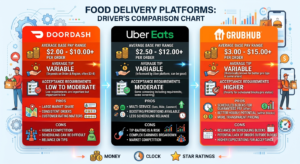
Food Delivery: DoorDash, Uber Eats, Grubhub
Food delivery has exploded in popularity and often offers more flexibility than rideshare since deliveries are shorter and you don’t have passengers in your car.
Earnings Breakdown
Base pay structure:
- Base pay per delivery: $2-$10 (based on distance, time, desirability)
- Customer tips: $0-$10+ (average $3-$5)
- Promotions and bonuses: Variable
Average earnings: $12-$25 per hour before expenses
The tip reality:
Unlike rideshare, you can see the tip amount upfront (DoorDash shows total payout including tip). This allows you to cherry-pick orders.
Example hourly breakdown:
- Complete 3 deliveries per hour
- Average $7 per delivery (base + tip)
- Gross: $21/hour
- Minus gas and expenses ($4/hour)
- Net: $17/hour before taxes
The Strategy for $20+ Per Hour
Accept/reject strategically:
The most important skill in food delivery is knowing which orders to decline.
Never accept:
- Orders under $1 per mile (e.g., $6 delivery going 8 miles)
- No-tip orders (unless very short distance during slow period)
- Long-distance orders to areas with few restaurants (dead miles back)
- Orders to difficult apartment complexes during peak time
Always accept:
- $2+ per mile orders
- Short deliveries with good tips to busy areas
- Stacked orders (multiple deliveries in one trip) if route makes sense
Platform-specific tips:
DoorDash:
- “Top Dasher” status (70%+ acceptance rate) gives priority access to orders
- However, maintaining this often means accepting unprofitable orders
- Most experienced dashers ignore this and focus on profitable orders only
Uber Eats:
- Shows estimated tip upfront
- “Uber Eats Pro” rewards based on points (not acceptance rate)
- Generally lower base pay than DoorDash but sometimes higher tips
Grubhub:
- Scheduled blocks vs. off-block
- Contribution guarantee if you maintain high acceptance during scheduled blocks
- Generally shows full payout upfront
Multi-Platform Strategy
The power of running multiple apps:
Experienced food delivery drivers run 2-3 apps simultaneously:
- Turn on DoorDash, Uber Eats, and Grubhub at the same time
- Accept the best order from any platform
- Pause the other apps while completing the delivery
- Turn them all back on when finished
This strategy:
- Eliminates dead time waiting for orders
- Allows you to be highly selective (only $2+/mile orders)
- Can increase earnings by 30-50% compared to single-app drivers
Warning: Never accept orders from multiple apps simultaneously unless the routes align perfectly. Late deliveries hurt your ratings.
Peak Times for Food Delivery
Highest earning periods:
- Lunch rush: 11:30 AM – 1:30 PM
- Dinner rush: 5:30 PM – 8:30 PM
- Late-night: 9:00 PM – 12:00 AM (especially Friday/Saturday)
Best days:
- Friday: Dinner and late-night
- Saturday: All day (lunch, dinner, late-night)
- Sunday: Brunch and dinner
The weekend warrior approach:
Work only Friday dinner through Sunday dinner (approximately 18-20 hours) and earn $350-$500.
https://trendminers.online/freelancing-for-beginners/
Grocery and Package Delivery
These platforms offer alternatives to food delivery with their own advantages and challenges.
Instacart (Grocery Shopping and Delivery)
How it works:
Accept a batch (shopping list), go to the grocery store, shop for items using the app, and deliver to the customer.
Earnings:
- Batch payments: $7-$20+ (based on item count, distance, store)
- Tips: $5-$50+ (typically 5-15% of order total)
- Average: $15-$25 per hour
Time investment per batch:
- Small order (20 items): 30-45 minutes total
- Medium order (40 items): 60-75 minutes
- Large order (60+ items): 90-120 minutes
Strategy for maximizing income:
Accept large orders with good tips:
A 50-item order paying $40 ($25 batch + $15 tip) that takes 75 minutes is better than two small $12 orders taking 30 minutes each.
Know your stores:
Become an expert at 2-3 local stores. You’ll shop faster, which increases your hourly rate.
Communicate with customers:
- Message immediately when starting
- Ask about replacements for out-of-stock items
- Send a friendly message before checkout
- Send arrival message when delivering
Good communication significantly increases tips.
Heavy pay bonus:
Orders with cases of water, bulk items trigger a heavy pay bonus ($5-$15 extra).
Shipt (Grocery Delivery)
Similar to Instacart but with key differences:
Pay structure:
- Base pay: $5-$15
- Tips: Customer decides after delivery (not shown upfront)
- Promo pay: Bonuses for difficult time slots
Membership model:
Shipt customers are often more affluent (Target shoppers) and may tip better, but the lack of upfront tip transparency is a gamble.
Amazon Flex (Package Delivery)
How it works:
Reserve delivery blocks (usually 3-4 hour shifts), pick up packages from Amazon facility, deliver using their app.
Earnings:
- Base rate: $18-$25 per hour
- Surge rates during busy times: $30-$40+ per hour
- Paid for the block regardless of how fast you finish
The strategy:
- Reserve blocks during high-demand times (holidays, Prime Day)
- If you finish a 4-hour block in 2.5 hours, you still get paid for 4
- Efficiency directly increases your effective hourly rate
Challenges:
- Requires a larger vehicle for some routes (many packages)
- Standing/lifting required
- Strict delivery time windows
Task-Based Gig Platforms
These platforms match you with local tasks ranging from furniture assembly to dog walking.
TaskRabbit
Services offered:
- Furniture assembly (IKEA is huge demand)
- Moving help
- Handyman tasks
- Cleaning
- Yard work
- Organization
Earnings:
- You set your own hourly rate ($30-$100+ depending on skill)
- TaskRabbit takes a 15-30% service fee
- Net rate: $25-$70+ per hour
Getting started:
- Pass background check
- Create detailed profile highlighting skills
- Upload photos of past work
- Start with competitive rates to build reviews
Once established (20+ reviews), raise rates 20-30%.
Rover and Wag (Pet Care)
Services:
- Dog walking: $15-$30 per 30-minute walk
- Drop-in visits: $20-$40 per visit
- Overnight sitting: $40-$100 per night
- Doggy daycare: $30-$60 per day
Earnings potential:
Build a base of 5-10 regular clients (daily walks) for consistent $500-$1,500 monthly income.
Strategy:
- Start rates 20% below market to build reviews
- Offer package deals (5 walks for price of 4)
- Send photo updates to clients (they love this, leads to tips)
- Build recurring weekly clients for predictable income
Managing Expenses and Maximizing Profit
The biggest mistake new gig workers make is focusing only on gross income and ignoring the expenses eating away at their earnings.
Vehicle Expense Tracking
You have two options for tax deductions:
Standard mileage rate (easiest):
- Track all business miles driven
- Deduct 67 cents per mile (2024 rate)
- This covers gas, maintenance, depreciation, insurance
Example: Drive 15,000 gig miles = $10,050 deduction
Actual expense method:
- Track all vehicle expenses (gas, oil changes, repairs, insurance, registration, car washes)
- Calculate business use percentage
- Deduct that percentage of total expenses plus depreciation
Which is better?
For most gig workers, the standard mileage rate is simpler and often more beneficial unless you drive an expensive vehicle or have very low mileage.
Critical: You MUST track miles contemporaneously (as you drive them). A spreadsheet created in April claiming to remember miles from January won’t hold up in an audit.
Apps that auto-track mileage:
- MileIQ ($5.99/month) – Automatic tracking, swipe to categorize
- Stride (Free) – Made specifically for gig workers
- Everlance ($8/month) – Tracks mileage and expenses
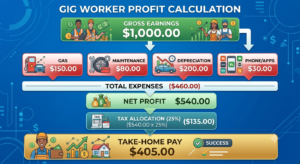
Understanding Your True Costs
Don’t just track miles—understand cost per mile:
Total vehicle costs per mile (typical):
- Gas: $0.12-$0.15 per mile (at $3.50/gallon, 25 mpg)
- Maintenance: $0.05-$0.08 per mile
- Depreciation: $0.15-$0.25 per mile
- Insurance increase: $0.02-$0.05 per mile
- Total: $0.34-$0.53 per mile
This means a $12 food delivery going 10 miles:
- Gross earnings: $12
- Minus cost (10 miles × $0.40): $4
- Net earnings: $8
- If it took 30 minutes: $16/hour (before taxes)
Quarterly Tax Payments
As an independent contractor, you’re responsible for paying estimated taxes quarterly.
What you owe:
- Income tax: Based on your tax bracket (12-37%)
- Self-employment tax: 15.3% on your net profit
Combined, set aside 25-30% of your NET profit for taxes.
Quarterly payment deadlines:
- April 15 (Jan 1 – March 31)
- June 15 (April 1 – May 31)
- September 15 (June 1 – Aug 31)
- January 15 (Sept 1 – Dec 31)
Failure to pay quarterly results in underpayment penalties.
For comprehensive tax guidance, read: Self-Employed Tax Guide: Write-Offs and Deductions You’re Missing
Advanced Strategies for Serious Gig Workers
Once you understand the basics, these advanced tactics can significantly boost your earnings.
The Market Arbitrage Strategy
Some gig workers exploit pricing differences between platforms.
Example:
- Accept a high-paying Uber ride going 30 minutes outside the city
- Turn on DoorDash in that area for the return trip
- Get paid for both directions instead of dead miles back
The Strategic Scheduling Approach
Track your market’s patterns for 2 weeks:
- Which hours produce the highest per-hour earnings?
- Which hours are dead?
- Where are the hotspots?
Then build your schedule around the top 20 hours per week.
Working smart 20 hours often earns more than grinding 40 hours of mixed quality time.
The Tax Optimization Strategy
Maximize deductions:
- Phone bill (business use percentage)
- Phone accessories (car mounts, chargers)
- Insulated bags for food delivery
- Cleaning supplies for rideshare
- Parking and tolls
- Roadside assistance memberships
Consider business structure:
Once you’re earning $50,000+ annually, consult a CPA about forming an LLC or S-Corp. The self-employment tax savings can be substantial.
The Customer Service Excellence Approach
Higher ratings = more opportunities:
For rideshare:
- Maintain 4.8+ rating
- 95%+ acceptance rate for bonuses (if pursuing them)
- Keep cancellation rate under 5%
For food delivery:
- 95%+ on-time delivery
- 4.7+ customer rating
- Friendly, professional communication
Top-rated workers often get:
- Priority access to high-paying orders
- Qualification for special promotions
- Better customer matching (Instacart preferred shoppers)
Protecting Yourself as a Gig Worker
The flexibility of gig work comes with risks that employees don’t face.
Insurance Considerations
Personal auto insurance doesn’t cover commercial use.
Your options:
Rideshare insurance:
- Offered by most major insurers
- Covers the gap between personal use and when the app’s insurance kicks in
- Costs $10-$30 extra per month
Commercial insurance:
- Required if you’re driving more than 20 hours/week
- More expensive ($200-$400/month) but provides full coverage
For delivery:
Most platforms provide some coverage while on an active delivery, but check the details. Your personal policy may not cover an accident while delivering food.
Emergency Fund
Without sick days or unemployment benefits, you need a robust emergency fund.
Target: 6 months of expenses saved
Why it’s critical:
- Car breakdown means no income until repaired
- Injury or illness means zero income
- Platform deactivation (unfair or not) means instant income loss
Diversification
Never depend on a single platform.
If Uber deactivates your account (wrongly or rightly), you need immediate backup income.
Smart gig workers:
- Maintain active accounts on 3-5 platforms
- Rotate between them to keep accounts active
- Can shift focus instantly if one platform changes terms
- https://trendminers.online/selling-on-amazon-fba/
Frequently Asked Questions
How much can I realistically earn per week?
It varies dramatically by market and hours worked. In a strong market, working 35-40 hours per week across multiple platforms can generate $700-$1,200 gross ($500-$900 net after expenses). Rural areas may be 30-50% lower. Urban markets 20-40% higher.
Do I need a special driver’s license?
No. A regular driver’s license is sufficient for rideshare and delivery. Commercial driver’s licenses (CDL) are only required for large trucks and buses.
Can I write off my car payment?
Not directly. If you use the standard mileage deduction, your car payment isn’t separately deductible (depreciation is included in the rate). If you use the actual expense method, you can deduct depreciation, but not the principal portion of a car loan payment.
What happens if I get into an accident while working?
Most platforms provide liability coverage while you’re actively on a trip or delivery. During the time you’re online but haven’t accepted a trip, coverage is limited. This is why rideshare gap insurance is important. Always report accidents to both your insurance and the platform immediately.
Can I do this full-time?
Yes, many people support themselves full-time through gig work. However, factor in lack of benefits (health insurance, retirement, paid time off) when comparing to traditional employment. Full-time gig workers should earn 30-40% more gross income than their previous W-2 job to achieve equivalent net compensation.
Conclusion: Is Gig Work Right for You?
The gig economy offers unprecedented flexibility and earning potential for those who approach it strategically. It’s not effortless money, but it is accessible money for anyone willing to put in the work and optimize their approach.
Gig work is ideal if you:
- Need flexible scheduling around school, family, or another job
- Want to earn extra money without long-term commitment
- Are between jobs and need immediate income
- Prefer autonomy over structure
Gig work is challenging if you:
- Need consistent, predictable income
- Can’t tolerate income fluctuation
- Don’t have discipline for self-employment taxes
- Require employer-provided health benefits
Your action plan to start earning this week:
- Choose your platform(s) based on what you have available (vehicle type, free time)
- Sign up and complete background checks (2-7 days typically)
- Download mileage tracking app and set it up before your first delivery
- Start conservatively (10-15 hours) to learn the ropes
- Track your actual net earnings for 2 weeks before scaling up
- Open a separate bank account for gig income and transfer 30% of earnings immediately for taxes
The gig economy won’t make you rich overnight, but with the right strategy, it can provide meaningful income on your terms.
Expand your income strategy:
- Explore more opportunities: 25 Legitimate Side Hustles That Pay $500+ Per Month
- Build something bigger: How to Start a Profitable Side Business While Working Full-Time
- Master your taxes: Self-Employed Tax Guide: Write-Offs and Deductions You’re Missing
- Manage your money: How to Create a Personal Budget That Actually Works in 2026