
Introduction
You’ve got a brilliant business idea. You can see the potential. You’ve done the mental math and know it could generate real income—maybe even replace your salary someday. There’s just one problem: you have a full-time job that pays your bills, provides health insurance, and offers financial stability you can’t afford to lose.
The good news? You don’t have to choose between security and entrepreneurship. Thousands of successful businesses were started by people working full-time jobs—from Apple (Steve Wozniak worked at HP) to Under Armour (Kevin Plank worked in corporate sales) to Spanx (Sara Blakely sold fax machines door-to-door).
Starting a side business while employed full-time is not only possible—it’s often the smartest approach. You get to validate your business idea without the crushing pressure of needing immediate income. You can experiment, fail, learn, and pivot without risking your family’s financial security.
However, balancing a demanding full-time job with the equally demanding work of building a business requires strategy, discipline, and a clear roadmap. You’ll face challenges like time constraints, energy management, potential conflicts of interest, and the inevitable question: “When do I finally make the leap?”
https://trendminers.online/legitimate-side-hustles/
This comprehensive guide will walk you through every step of launching a profitable side business while maintaining your full-time employment. You’ll learn how to find the right business idea, manage your limited time effectively, handle the legal and tax implications, and ultimately build something that could become your path to financial independenc.start a side business while working full-time
For complementary strategies on generating extra income quickly, check out: 25 Legitimate Side Hustles That Pay $500+ Per Month
Why Starting a Side Business While Employed Is Actually Smarter
Before diving into the “how,” let’s address why maintaining your job while building your business is often the optimal strategy.
Financial Security and Risk Mitigation
Your full-time salary provides a safety net that allows you to take calculated risks with your business. You can invest in quality tools, marketing, and inventory without the desperate pressure of needing immediate returns. You’re not forced into poor decisions because you need to make payroll or pay rent.
Real-world scenario: If a product launch flops or a client doesn’t pay on time, your family’s health insurance doesn’t disappear and your mortgage still gets paid.
Validation Without Pressure
You can test your business idea in the real market without betting everything on an unproven concept. If your target market doesn’t respond the way you hoped, you have the breathing room to pivot or shut down without catastrophic consequences.
Many would-be entrepreneurs quit their jobs only to discover their “guaranteed success” idea doesn’t actually solve a problem people will pay for. Testing while employed eliminates this devastating scenario.
Access to Resources
Your full-time job provides more than just a paycheck:
- Health insurance: Healthcare coverage for you and your family
- Professional network: Potential first customers or mentors
- Skills development: Learning on someone else’s dime
- Equipment and tools: Sometimes legitimately usable for your business
- Credibility: Banks and investors view employed entrepreneurs as lower risk
Sustainable Growth Timeline
Building a business properly takes time. Most successful businesses take 12-36 months to reach profitability. Having employment income means you can build strategically rather than desperately.
You can say “no” to low-quality clients, negotiate better terms with vendors, and invest in long-term growth rather than short-term survival.
Step 1: Choose the Right Business Idea
Not all business ideas are suitable for someone working full-time. You need a business model that fits your constraints.
Characteristics of a Good Side Business
Limited time requirements initially: You can launch with 5-15 hours per week and scale from there.
Flexible scheduling: Work can be done evenings, early mornings, or weekends on your own timeline.
Low initial overhead: Doesn’t require massive upfront capital or ongoing fixed costs like rent.
Scalable systems: Can eventually be systematized or outsourced so it doesn’t always require your direct labor.
No conflict of interest: Doesn’t compete with or violate the terms of your current employment.
Business Models That Work Well for Full-Time Employees
Service-Based Businesses
- Freelance consulting in your area of expertise
- Virtual assistant services
- Bookkeeping or financial planning
- Web design or development
- Social media management
- Copywriting or content creation
Advantage: Low startup costs, use existing skills, immediate revenue potential.
Consideration: Directly trades time for money initially, but can be systematized.
E-commerce Businesses
- Print-on-demand products (t-shirts, mugs, phone cases)
- Amazon FBA (Fulfillment by Amazon)
- Dropshipping
- Etsy digital products
- Online course creation
Advantage: Can be automated, passive income potential, unlimited scalability.
Consideration: Requires upfront work before revenue, longer path to profitability.
For a deep dive into Amazon FBA, see our upcoming guide: Selling on Amazon FBA: Complete Beginner’s Guide to E-commerce
Productized Services
- SEO audits (fixed-price, templated service)
- Resume writing packages
- Brand identity design packages
- Website maintenance retainers
Advantage: Higher value than hourly work, more predictable than custom services.
Consideration: Requires systemization and clear scope definition.
Digital Products
- Online courses
- E-books
- Templates and tools
- Stock photography
- Software plugins or apps
Advantage: Create once, sell infinitely, true passive income.
Consideration: High upfront time investment before first sale.
Validating Your Idea Before Going All-In
Don’t spend six months building something nobody wants. Validate demand first.
The Validation Process:
- Market Research: Are people already paying for solutions to this problem? Search for competitors—if you find them, that’s good news (proven market).
- Pre-sell if possible: Before building the full product or service, can you get 5-10 people to commit or pre-pay?
- Minimum Viable Offering: Launch the simplest version of your idea quickly to test market response.
- Talk to potential customers: Conduct 10-15 conversations with your target market. What are their real pain points?
Example: Before building a full online course, create a free webinar or PDF guide. If 100+ people download it and you get questions asking for more, you’ve validated interest.
https://trendminers.online/freelancing-for-beginners/
Step 2: Manage Your Time Like a CEO
Time is your scarcest resource. You already work 40+ hours per week. Add commuting, family obligations, and basic life maintenance—there’s not much left.
The Time Audit
Before adding business work, you need to know where your time currently goes.
Track one week:
- Log every activity in 30-minute blocks
- Include work, commute, meals, TV, social media, sleep, family time
Most people discover:
- 10-15 hours per week of “wasted” time (excessive social media, low-value TV)
- Inefficient morning or evening routines
- Poor work boundaries (staying late for non-critical tasks)
The goal: Find 10-15 hours per week you can reallocate to your business.
The Time-Blocking Strategy
Don’t rely on “finding time.” Schedule your business work like you schedule meetings.
Recommended schedule for beginners:
Weekday mornings (5:30 AM – 7:00 AM): 7.5 hours per week
- Deep work time before family wakes up
- Handle high-value tasks requiring focus
Weekday evenings (8:00 PM – 10:00 PM): 6-8 hours per week
- After family obligations
- Administrative tasks, customer communication, content creation
Weekend mornings (Saturday 6:00 AM – 11:00 AM): 5 hours per week
- Strategic planning, learning, business development
Total: 18-20 hours per week available for business building
The key: Protect these blocks as non-negotiable appointments with yourself.
Energy Management Matters More Than Time Management
Not all hours are created equal. Working on your business when you’re exhausted produces poor results.
Match tasks to energy levels:
High energy (mornings, after exercise):
- Creative work (product development, content creation)
- Strategic planning
- Sales conversations
- Complex problem-solving
Medium energy (mid-day, early evening):
- Administrative tasks
- Email responses
- Social media posting
- Research
Low energy (late evening, after long workday):
- Routine tasks (data entry, organizing)
- Consuming educational content (podcasts, reading)
- Planning tomorrow’s priorities
The 80/20 Rule for Side Businesses
When time is limited, focus ruthlessly on the 20% of activities that generate 80% of results.
High-impact activities:
- Direct sales and marketing
- Product/service delivery
- Building systems to save future time
- Customer relationship building
Low-impact activities (eliminate or outsource):
- Perfecting your logo
- Building the “perfect” website
- Researching endlessly without taking action
- Organizing files and folders
- Low-value administrative tasks
Example: Spend 80% of your business time talking to potential customers and delivering your service, and only 20% on everything else.

Step 3: Handle the Legal and Ethical Considerations
Failing to address these properly can jeopardize both your job and your business.
Review Your Employment Contract
Before launching anything, carefully review your employment agreement for:
Non-compete clauses: Do you agree not to work in a competing business during or after employment?
Intellectual property agreements: Does your employer claim ownership of anything you create, even on your own time?
Moonlighting policies: Does your company explicitly prohibit outside employment or business ownership?
Confidentiality agreements: Are you prohibited from using company information, even general industry knowledge?
If you find restrictive clauses:
- Consult with an employment attorney ($200-500 for a consultation)
- Consider whether your business idea truly conflicts
- In some cases, you can request written permission from your employer
Avoid Conflicts of Interest
Clear violations (never do these):
- Competing directly with your employer
- Using company time, equipment, or resources for your business
- Soliciting your employer’s clients or employees
- Using proprietary information or trade secrets
Gray areas (proceed carefully):
- Serving a different market segment than your employer
- Using general industry knowledge (not trade secrets)
- Working in an adjacent but non-competing field
Best practice: Full transparency. Some employers are supportive of employee entrepreneurship, especially if it doesn’t compete. Having the conversation upfront prevents issues later.
Choose the Right Business Structure
You have several options for structuring your business:
Sole Proprietorship (Default)
- Setup: None needed, you’re automatically a sole proprietor when you start earning
- Taxes: Report on Schedule C of your personal tax return
- Liability: No separation between personal and business
- Best for: Low-risk service businesses, testing an idea
Single-Member LLC
- Setup: File Articles of Organization with your state ($50-$500)
- Taxes: Pass-through taxation (same as sole proprietor by default)
- Liability: Separates personal and business assets
- Best for: Businesses with any liability risk, professional appearance
S-Corporation (Election)
- Setup: Form LLC or corporation, then elect S-Corp tax treatment
- Taxes: Can save on self-employment taxes once profitable
- Complexity: Requires payroll, separate tax return
- Best for: Businesses earning $60,000+ profit annually
For most side businesses earning under $50,000/year, a sole proprietorship or single-member LLC is sufficient.
For detailed tax guidance, read: Self-Employed Tax Guide: Write-Offs and Deductions You’re Missing
Business Licenses and Permits
Requirements vary by location and industry. Research your specific needs:
Common requirements:
- Business license from your city or county ($50-$400)
- DBA (“Doing Business As”) if operating under a name other than your own
- Sales tax permit if selling physical products
- Professional licenses for certain industries (contracting, cosmetology, financial services)
Where to check:
- Your city’s business licensing department website
- SBA.gov’s local assistance directory
- Your state’s Secretary of State website
Step 4: Set Up Essential Business Systems
Even a small side business needs basic infrastructure to operate professionally and legally.
Financial Infrastructure
Separate Business Bank Account
Open a dedicated business checking account immediately. This is crucial for:
- Clean accounting (separating business from personal)
- Professional appearance
- Simplified taxes
- Legal protection (if you have an LLC)
Most banks offer free business checking for small businesses.
Accounting System
You need a system to track income and expenses from day one.
Options:
- Spreadsheet (Free): Acceptable for very simple businesses under $10,000/year
- Wave (Free): Basic accounting software, invoicing, receipt scanning
- QuickBooks Self-Employed ($15/month): Excellent for freelancers and solo businesses
- FreshBooks ($17/month): User-friendly for service businesses
Payment Processing
How will customers pay you?
For services:
- PayPal or Venmo (simple, but higher fees)
- Stripe (professional, integrates with invoicing)
- Square (good for in-person and online)
For e-commerce:
- Shopify Payments (integrated with Shopify stores)
- Stripe (works with most platforms)
Set aside 25-30% of all revenue for taxes. This is non-negotiable. Open a separate savings account and transfer this immediately when paid.
Time-Saving Automation
When you’re working full-time, automation is essential.
Automate these tasks:
Email marketing: Mailchimp, ConvertKit, or ActiveCampaign
- Set up welcome sequences
- Automate promotional emails
Social media posting: Buffer, Hootsuite, or Later
- Schedule a week’s worth of content in one sitting
Appointment scheduling: Calendly or Acuity
- Let clients book time automatically without email back-and-forth
Invoicing: QuickBooks, FreshBooks, or Wave
- Set up recurring invoices for retainer clients
- Automate payment reminders
Customer relationship management: HubSpot (free), Airtable, or Notion
- Track leads and customer communication
The automation rule: If you do something more than three times, create a system or template for it.
Step 5: Create a Strategic Business Plan
You don’t need a 40-page formal business plan, but you do need clarity on your strategy.
The One-Page Business Plan
Answer these essential questions:
What problem do you solve?
Be specific. “I help busy professionals manage their social media” is better than “I do marketing.”
Who is your ideal customer?
Demographics, psychographics, pain points. The more specific, the better your marketing.
What is your unique value proposition?
Why should someone choose you over competitors?
Revenue model:
How do you make money? Pricing structure? Payment terms?
Marketing strategy:
How will you find customers? What channels will you use?
Financial goals:
- Month 1-3: $X in revenue
- Month 4-6: $X in revenue
- Month 7-12: $X in revenue
- Year 2: $X in revenue
Success metrics:
What key numbers will you track weekly? (leads generated, conversion rate, revenue, profit margin)
Setting Realistic Milestones
Months 1-3: Foundation Phase
- Legal setup complete
- First 3-5 paying customers
- Basic systems in place
- Revenue target: $500-$2,000
Months 4-6: Validation Phase
- 10-20 paying customers
- Refine offering based on feedback
- Revenue target: $2,000-$5,000/month
Months 7-12: Growth Phase
- Consistent customer acquisition
- Beginning to systematize and delegate
- Revenue target: $5,000-$10,000/month
Year 2: Scale or Decide
- Revenue: $10,000-$20,000/month
- Decision point: Stay as side business or transition to full-time?
Step 6: Launch and Get Your First Customers
You can have the perfect business plan, but nothing matters until you make your first sale.
The Fastest Path to Your First Customer
Leverage your existing network:
Your first customers are likely people who already know, like, and trust you.
The announcement:
Send a personal message (not mass email) to 20-30 people in your network:
“Hey [Name], I wanted to let you know I’ve started [business]. I’m helping [ideal customer] with [specific problem]. I know you [connection to the problem/know someone who has it]. Would you be open to a quick 15-minute call? I’d love your feedback, and if you know anyone who might benefit, I’d appreciate an introduction.”
Key: You’re asking for feedback and referrals, not pushing a hard sale.
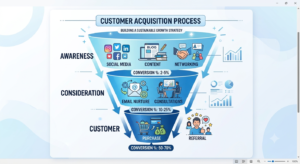
Leverage Free Marketing Channels
When you’re starting with no budget, focus on free marketing:
Content marketing:
- Start a blog or YouTube channel demonstrating your expertise
- Answer questions in your niche on Reddit, Quora, or industry forums
- Write guest posts for established blogs
Social media:
- LinkedIn for B2B services
- Instagram for visual products/services
- Twitter for thought leadership
- TikTok for younger demographics
Networking:
- Join local business groups and chambers of commerce
- Attend industry meetups and conferences
- Participate in online communities (Facebook groups, Slack channels)
Partnerships:
- Find complementary businesses and cross-promote
- Affiliate relationships
The content strategy: Create valuable content that demonstrates your expertise. People buy from those they perceive as experts.
The Service-First Approach
When starting out, overdeliver on service to build testimonials and referrals.
The first 10 customers:
- Charge 30-50% below your target rate
- Overdeliver on value (add bonuses, extra touches)
- Explicitly ask for testimonials and referrals
- Use their success stories in marketing
Once you have 10 great testimonials, increase your prices to full market rate.
https://trendminers.online/selling-on-amazon-fba/
Step 7: Balance Work, Business, and Life
The biggest challenge isn’t building the business—it’s sustaining the effort without burning out or damaging relationships.
Communicate with Your Family
Your business will require time that could otherwise go to family and personal life. Get buy-in upfront.
Have the conversation:
- Explain why this is important to you
- Share your vision and timeline
- Be specific about time commitments
- Ask for their support for a defined period (e.g., “I need focused evenings for the next 6 months”)
- Schedule protected family time that’s non-negotiable
Include your family in small wins: Share customer testimonials, celebrate milestones, let them see progress.
Protect Your Full-Time Job Performance
Your job is funding your business. Don’t jeopardize it.
Non-negotiables:
- Never work on your business during work hours
- Meet or exceed your job performance standards
- Don’t use company resources for personal business
- Maintain professional relationships
If performance slips, reassess your time allocation immediately.
Prevent Burnout
Running two jobs simultaneously is exhausting. Protect your wellbeing.
Essential practices:
- Sleep: 7-8 hours minimum. You can’t outwork bad sleep.
- Exercise: 30 minutes, 3-4x per week maintains energy
- Breaks: Take one full day per week completely off
- Boundaries: When you’re “off,” be fully present (no email checking during family dinner)
Warning signs of burnout:
- Constant exhaustion even after rest
- Declining performance at your job
- Irritability with family and friends
- Loss of enthusiasm for the business
- Health issues (headaches, insomnia, anxiety)
If you experience these, scale back immediately. It’s better to slow the business temporarily than to crash completely.
Step 8: Know When to Make the Transition
At some point, you’ll face the decision: stay employed with a profitable side business, or take the leap to full-time entrepreneurship?
Financial Benchmarks for Going Full-Time
Don’t quit your job until:
Your business consistently earns 80-100% of your take-home salary for at least 6 months. One or two big months don’t count. You need consistent, predictable revenue.
You have 6-12 months of living expenses saved. Business income can be volatile. A cushion prevents desperation decisions.
You have a plan for health insurance. Research marketplace plans and factor this cost into your budget.
You’ve replaced employer benefits. Calculate the full value of your compensation package, including:
- Health insurance
- Retirement matching
- Paid time off
- Life insurance
- Disability insurance
Example calculation:
- Base salary: $70,000
- Health insurance value: $12,000
- 401k match: $3,500
- Total compensation: $85,500
Your business needs to consistently generate $85,500+ annually to truly replace your job.
The “Side Business Forever” Option
Going full-time isn’t the only definition of success. Many people maintain profitable side businesses indefinitely:
Reasons to keep it as a side business:
- You love your primary career
- Employer benefits are too valuable to lose
- You enjoy the security of steady income
- The business is seasonal or project-based
- It generates meaningful extra income without requiring full-time hours
There’s no shame in a “forever side business” earning $2,000-$5,000/month while you maintain your career.
Common Mistakes to Avoid
Learning from others’ mistakes saves you time and money.
Mistake 1: Perfectionism Over Progress
The trap: Spending months perfecting your logo, website, and branding before launching.
The reality: Your first logo will likely change. Your website will evolve. Launch imperfectly and improve based on real customer feedback.
Better approach: Create a minimal viable brand (simple logo, basic one-page website) and launch within 2-4 weeks.
Mistake 2: Trying to Do Everything Yourself
The trap: “I can’t afford to outsource, so I’ll do my own bookkeeping, web design, logo creation, etc.”
The reality: Your time has value. Spending 15 hours learning web design to save $500 means you’re valuing your time at $33/hour. If you can earn $100/hour doing client work, you’ve lost money.
Better approach: Outsource low-value tasks once your revenue supports it. Focus your limited time on high-value activities only you can do.
Mistake 3: Underpricing to Get Customers
The trap: “I’ll charge $25/hour to get started, then raise prices later.”
The reality: Low prices attract bargain hunters, not ideal clients. You’ll work twice as hard for half the money, and raising prices later means losing those clients anyway.
Better approach: Research market rates and charge 80-90% of that from day one. Compete on value and service, not price.
Mistake 4: No Marketing Plan
The trap: “If I build it, they will come.”
The reality: The world is full of great products nobody knows about. Marketing isn’t optional.
Better approach: Spend at least 30% of your business time on marketing and customer acquisition. One customer isn’t enough—you need a pipeline.
Mistake 5: Mixing Business and Personal Finances
The trap: Using your personal account for business, planning to “sort it out later.”
The reality: Tax time becomes a nightmare, you can’t track profitability, and if you have an LLC, you risk piercing the corporate veil.
Better approach: Separate accounts from day one, no exceptions.
Frequently Asked Questions
How much money do I need to start a side business?
It depends on the business model. Service-based businesses can start with $0-$500 (website, business cards, basic tools). E-commerce businesses typically require $500-$2,000 (initial inventory, website, marketing). The key is to start lean and reinvest profits as you grow.
Should I tell my employer about my side business?
Check your employment contract first. If there’s no conflict of interest and no explicit prohibition, many experts recommend transparency to avoid future complications. However, if your business competes even tangentially, consult an attorney before disclosing.
How do I handle taxes for a side business?
You’ll pay income tax and self-employment tax (15.3%) on your net profit. Make quarterly estimated tax payments if you expect to owe more than $1,000. Track all business expenses—they’re tax-deductible. Consider working with a CPA for your first year. Read: Self-Employed Tax Guide: Write-Offs and Deductions You’re Missing
What if my side business fails?
Most businesses require pivots and adjustments before finding product-market fit. Failure isn’t final—it’s feedback. The advantage of starting while employed is that “failure” just means trying a different approach, not financial devastation. Set a budget and timeline, and if the business isn’t working after that period, you can shut down without major consequences.
Can I build a side business with only 5-10 hours per week?
Yes, especially in the beginning. Many successful businesses started with founders working just a few hours weekly. Focus on high-impact activities, leverage automation, and be patient. Progress compounds over time.
Conclusion: Your Journey Starts Today
Starting a profitable side business while working full-time is one of the most intelligent financial moves you can make. It provides a path to increased income, financial security, skill development, and potentially, full-time entrepreneurship—all without the crushing risk of quitting your job prematurely.
The key is to start smart:
- Choose a business model that fits your constraints
- Manage your time ruthlessly
- Handle legal and ethical considerations properly
- Launch quickly and iterate based on feedback
- Balance work, business, and life sustainably
Your action plan for this week:
- Choose your business idea (or narrow to 2-3 options)
- Review your employment contract for conflicts
- Conduct a time audit to find 10-15 available hours
- Research 5 potential first customers
- Set your 90-day revenue goal
Remember, every successful entrepreneur started exactly where you are now. The difference between them and everyone else who “thought about it someday” is that they took action.
Your side business journey begins with a single step. Take it today.
Continue building your business foundation:
- Find your first income stream: 25 Legitimate Side Hustles That Pay $500+ Per Month
- Master your taxes: Self-Employed Tax Guide: Write-Offs and Deductions You’re Missing
- Learn to sell: Freelancing for Beginners: How to Land Your First Client
- Explore e-commerce: Selling on Amazon FBA: Complete Beginner’s Guide to E-commerce